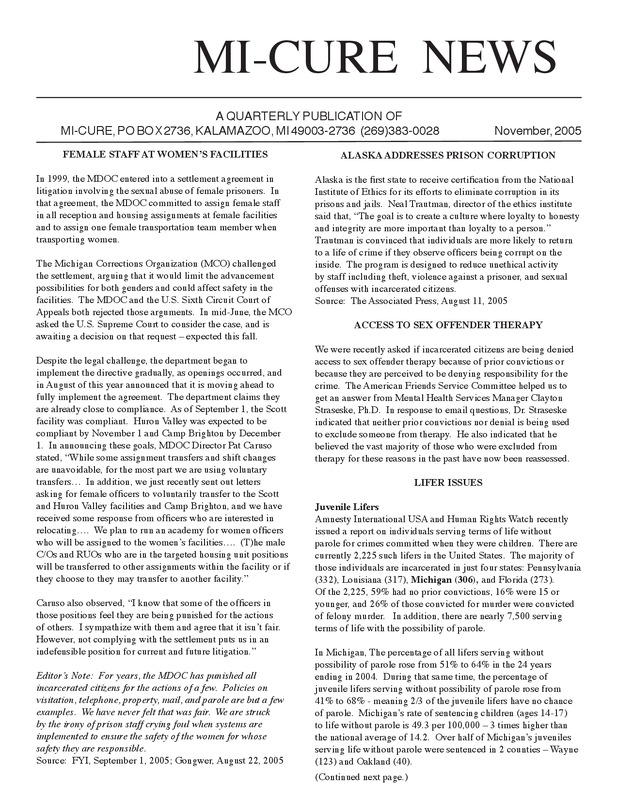
MI-CURE News (November 1990) covering prison visitation advocacy; opposition to a female boot camp; updates on the Kalamazoo Citizens Advisory Board; member engagement efforts; and developments on the Racial Justice Act.
MI-CURE News (November 1991) covering a grant from the National Campaign for Human Development; advocacy for prison conditions, rehabilitation, and parole reform; and updates on Michigan’s Parole Board, including leadership changes and new computerized Parole Guidelines.
MI-CURE News (November 1992) covering new publications on inmate relationships and pre-sentence reports; updates on rule changes and visitation policies; opposition to D.C.’s death penalty initiative; and a new national CURE chapter on reentry support.
MI-CURE News (November 1993) covering updates on visitor restrictions; National CURE discussions on prison privatization and advisory boards; fundraising efforts; and 1993-94 advocacy priorities, including sentencing, parole, treatment, and inmate phone policies.
MI-CURE News (November 1994) covering advocacy and legislative updates; National CURE’s push for Citizens Advisory Boards; delays in parole and sentencing guidelines legislation; concerns over inmate phone costs and visitation rules; and legal updates on the Cain case regarding inmate property limitations.
MI-CURE News (November 1995) covering new visitation restrictions; legal challenges (Blank v. MDOC, Bazzetta v. McGinnis); hardships on inmates and families; a class-action suit against five-year flops for lifers and long indeterminates; voter registration efforts for families of incarcerated individuals; and a feature on the Learning System Education Committee.
MI-CURE News (November 1996) covering the Seeking Justice report debunking myths about incarceration and crime reduction; critiques of mandatory minimums, the criminal label, and the financial burden of prisons; concerns over Truth-in-Sentencing’s impact on parole; updates on MDOC administrative rule changes; and reflections from Nelson Mandela on imprisonment’s psychological toll.
MI-CURE News (November 1997) covering Governor Engler’s plan for five new prisons and out-of-state prisoner contracts; analysis of parole policies contributing to overcrowding; concerns over zero-tolerance parole violations and lack of alternative sentencing; updates on sentencing guidelines, truth-in-sentencing projections, excessive prison phone rates, and flawed parolee drug testing; and legal challenges to the Prison Litigation Reform Act and Parole Board decisions.
MI-CURE News (November 1998) covering the campaign against high prisoner phone costs; legislative battles over wiretapping prisoner calls; legal challenges to prisoner property restrictions (Cain v. MDOC) and visiting restrictions; continued lawsuits over abuse and inadequate healthcare for female prisoners; denial of UN access to Michigan prisons; and updates on truth-in-sentencing laws, new parole conditions, and prisoner rights advocacy.
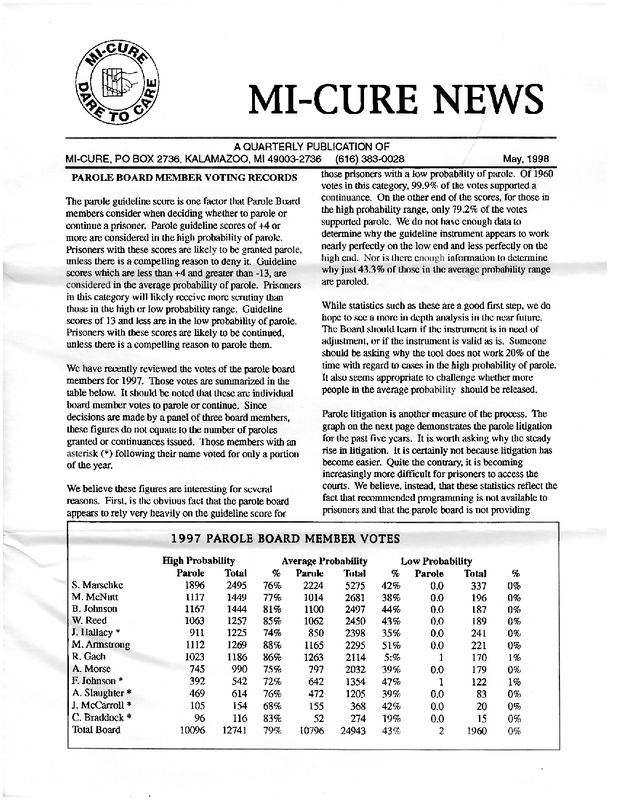
MI-CURE News (May 1998) covering parole board inconsistencies; therapy access issues; truth-in-sentencing laws; substance abuse treatment gaps; high prisoner phone costs; legal challenges to visiting and parole restrictions; reentry support efforts; and restorative justice advocacy.
MI-CURE News (November 1999) covering efforts to reduce prisoner phone costs; concerns over parole policies, including victim participation and limitations on lifer reviews; privatization of Michigan’s first children’s prison; termination of polygraph testing for sex offenders; legislative updates on prisoner lawsuits, ADA exemptions, and sex offender parole notifications; risks of media restrictions on prisoner interviews; inadequate prison substance abuse treatment; and advocacy for Mental Health Diversion Courts and sentencing reforms.
MI-CURE News (November 2000) covering excessive prisoner phone charges; MDOC’s new media restrictions limiting public oversight; research on lead poisoning's potential role in criminality; contradictions in official claims about Michigan’s private youth prison; truth-in-sentencing laws driving rising incarceration rates; prison guards’ union’s opposition to drug sentencing reform; legal updates on parole discharge authority, jury selection, and public defender policies; and MDOC’s removal of prisoners with HIV from food service jobs.
MI-CURE News (November 2001) covering the Equitable Telephone Charges Campaign; legal challenge Bazzetta v. McGinnis against MDOC’s restrictive visitation policies; rulings on parole board transparency, prior arrests as evidence, and youth offenders on the sex offender registry; concerns over MDOC’s legal mail policy; sentencing reforms in other states versus Michigan’s resistance; inadequate Hepatitis C treatment in prisons; and new statistics on prisoner deaths.
MI-CURE News (November 2002) covering efforts to reduce excessive prison phone rates; court rulings on sentencing errors, retroactive sex offender registration, and indigent defendants’ right to counsel; disparities in incarceration vs. education spending among Black Michiganders; concerns over MDOC’s restrictive mail policies and lack of oversight on prisoner treatment; prison education initiatives aimed at reducing recidivism; false-positive drug test risks for incarcerated individuals; and calls for continued advocacy on prison transparency, sentencing policies, and corporate accountability in corrections contracts.
MI-CURE News (November 2003) covering prison policy changes, legislative updates, and advocacy efforts; parole seminar insights; proposed reforms to felony murder appeals, sex offender registry, and prison phone rates; Governor Granholm’s veto of prison expansion and early release cost-saving measures; Michigan’s restrictive visitation policies reinstated; closure of the Corrections Ombudsman Office; and key court rulings on parole, legal mail, and sentencing.
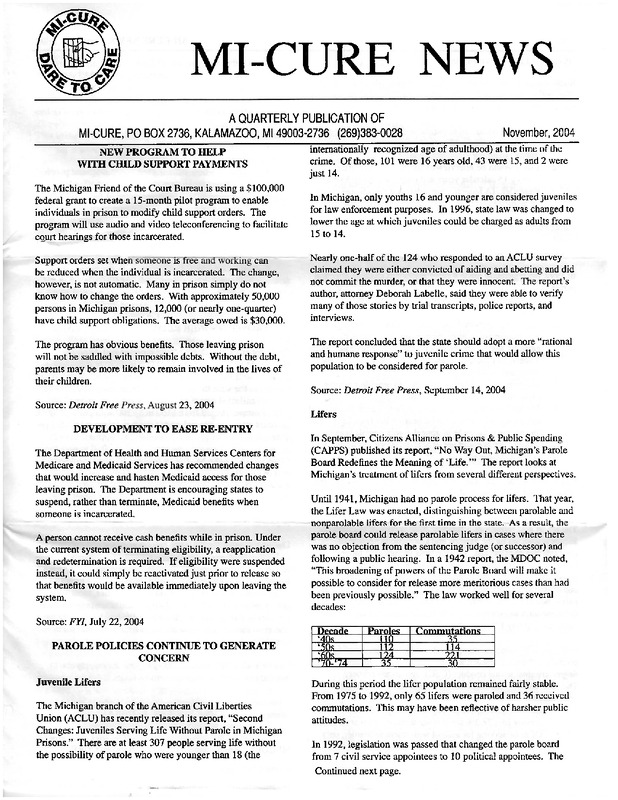
MI-CURE News (November 2004) covering child support modifications for incarcerated parents; Medicaid policy changes for reentry; reports on juvenile lifers and parole policies; Attorney General’s use of prisoner funds for bonuses; federal bills on mentally ill offenders and DNA testing; legal challenges to sentencing guidelines; ABA review of prison phone policies; indigent defense fee ruling; and UN prison standards.
MI-CURE News (November 2005) covering the ongoing legal challenges and implementation of female staff at women’s prisons; Alaska’s efforts to address prison corruption; updates on access to sex offender therapy; juvenile lifer sentencing and related advocacy for change; debates on closing Michigan’s youth prison; audits of MDOC’s educational programs and release date record-keeping; legislative updates, including proposed changes to criminal justice laws and the federal Streamlined Procedures Act; and the United Nations Standard Minimum Rules for the Treatment of Prisoners.
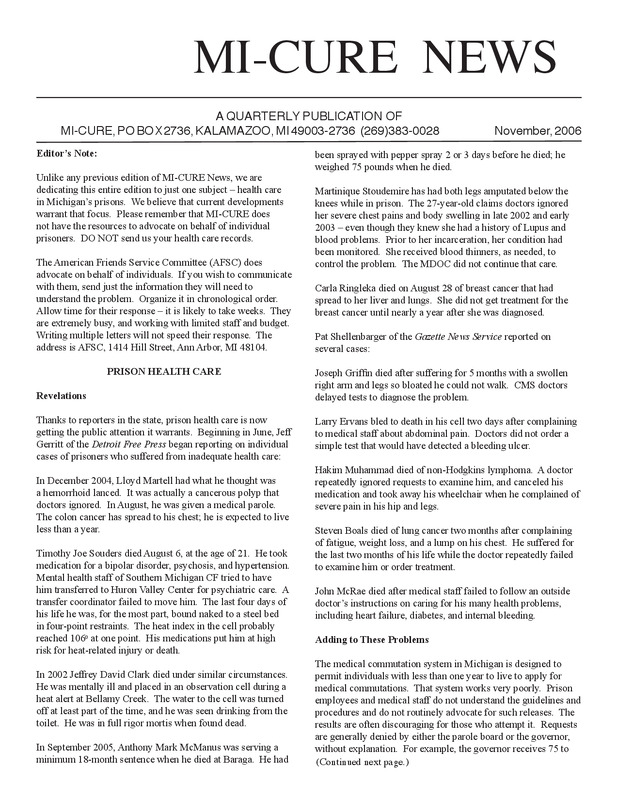
MI-CURE News (November 2006) covering inadequate health care in Michigan’s prisons; reports on individual cases of neglect leading to deaths, including cancer misdiagnoses and untreated mental health conditions; discussion on the failures of the medical commutation system and challenges in securing medical parole; recommendations from the Commission on Safety and Abuse in America’s Prisons for prison health care improvements; and announcement of a public hearing on prison health.
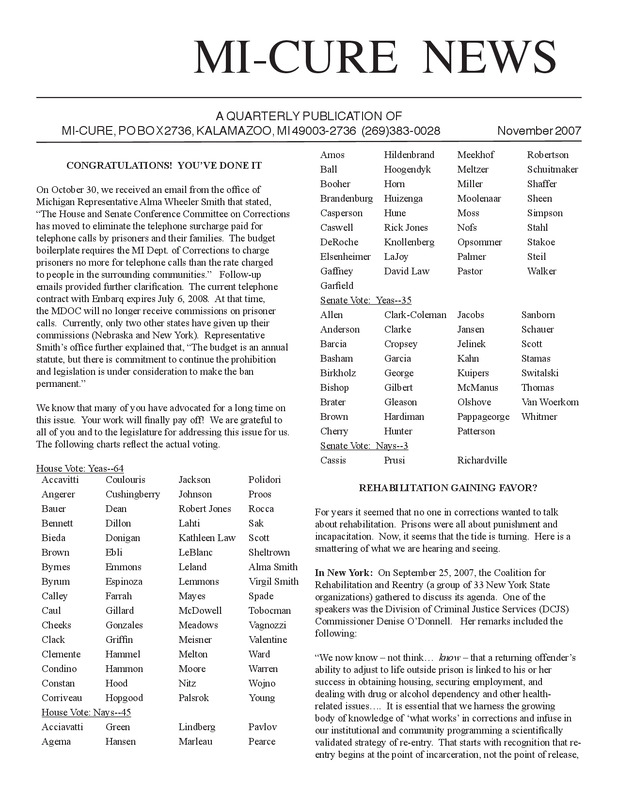
MI-CURE News (November 2007) covering recent victories in criminal justice reform, including Michigan’s successful move to eliminate telephone surcharges on prisoner calls; developments in rehabilitation and re-entry strategies including Medicaid restoration and laws protecting ex-offenders from employment discrimination; updates on efforts to reduce recidivism, such as Florida’s initiatives in substance abuse treatment and job training, and Oklahoma’s Transformational Justice Act aimed at improving re-entry programs; and legislative and court updates, including Michigan’s ruling on the rights of lifers and the classification of alcohol-related offenses.
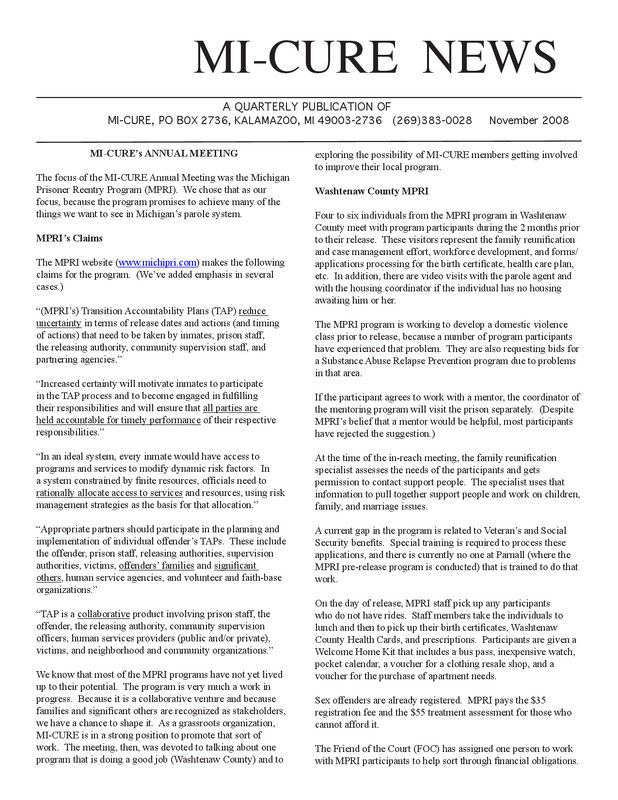
MI-CURE News (November 2008) covering the Michigan Prisoner Reentry Initiative (MPRI; other discussions include efforts to reduce recidivism through fairer employment opportunities for people with felony convictions; the creation of sex offender residency maps; significant developments such as the reduction in Michigan’s prison population, the closure of the Detroit crime lab, funding challenges faced by Prison Legal Services, and public policy debates around prison costs and sentencing reform.
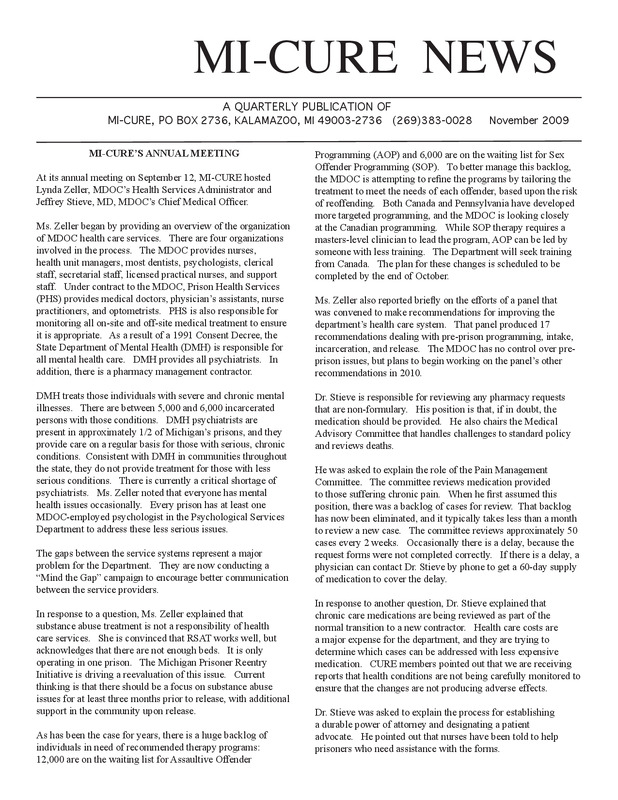
MI-CURE NEWS (November 2009) covering MDOC health care services including the shortage of psychiatrists; updates on mental health treatment gaps and substance abuse programs; the "Mind the Gap" campaign to improve communication between service providers; challenges in managing chronic care medications and overcrowding in prisons; and the release of a CAPPS report highlighting the inefficiencies in parole denials and recidivism rates, alongside other states’ reforms to reduce prison populations.
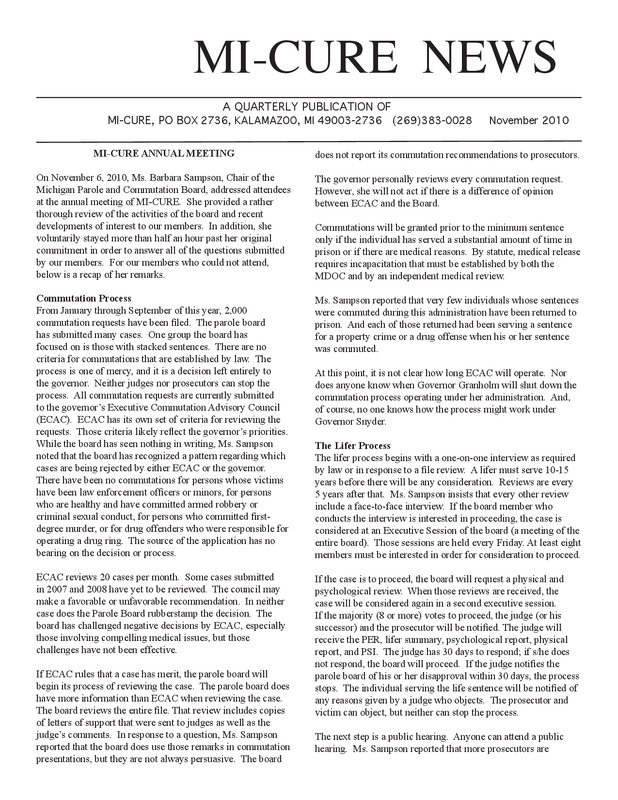
MI-CURE NEWS (November 2010) covering the commutation and parole processes, including criteria, decision-making, and the challenges of balancing fairness with public safety; updates on parole policies for lifers, non-lifers, and individuals with mental health issues; a report on the rising issue of "debtor prisons" in Michigan; recent legislative changes, including the removal of felony questions from Detroit job applications and discussions on restoring voting rights for incarcerated individuals in the UK; and ongoing efforts to train staff for the Violence Prevention Program in Michigan.
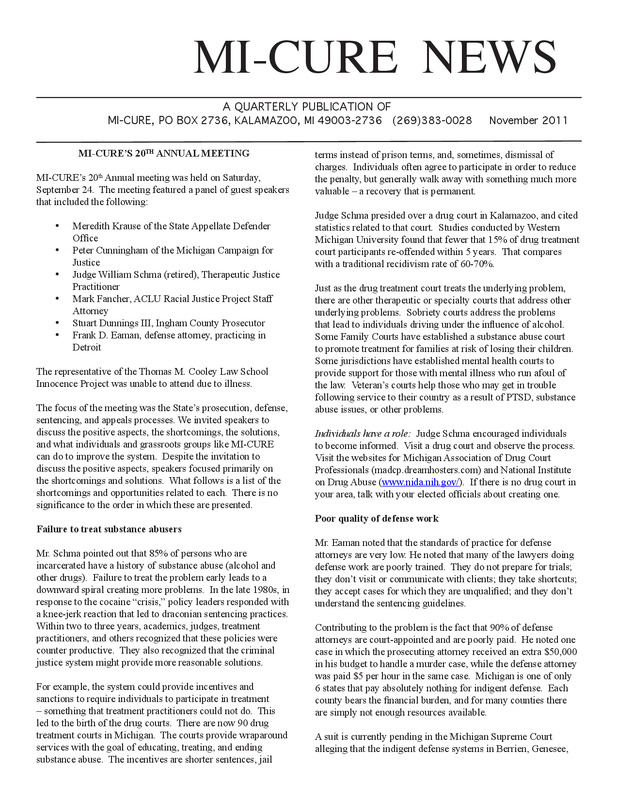
MI-CURE NEWS (November 2011) covering discussions on prosecution, defense, sentencing, and racial bias in the criminal justice system; substance abuse treatment, quality of defense work, racial profiling, and the need for reform in indigent defense; the closure of Mound Correctional Facility; privatization of healthcare services; and changes to prison food services.
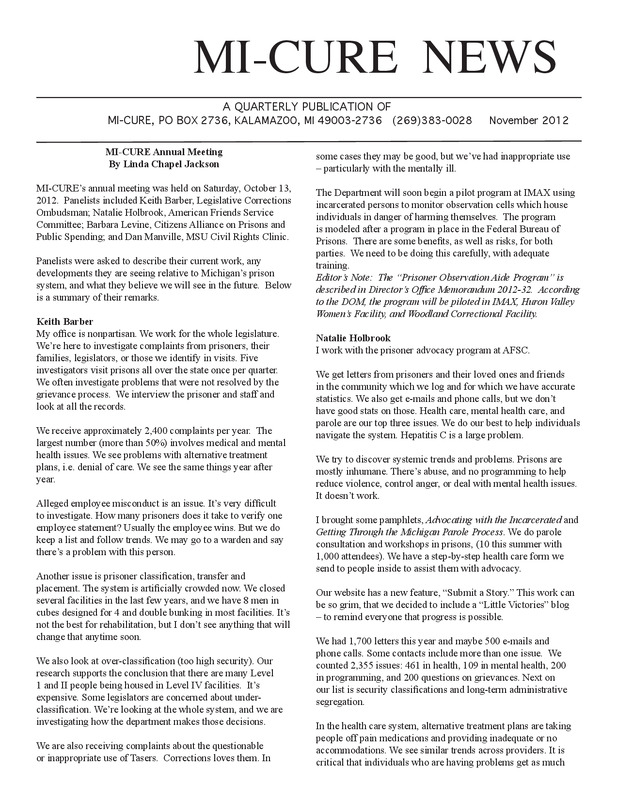
MI-CURE NEWS (November 2012) covering MI-CURE’s annual meeting including prisoner classification; overcrowding; misconduct investigations; use of tasers; healthcare, mental health; programming; long-term administrative segregation; rising prison costs; medical and mental health care litigation; parole violations, and juvenile life sentences.
MI-CURE NEWS (November 2013) covering FCC ruling update on phone rates; continued concerns about Taser use in prisons; backlog in VPP, SOP, and T4C programs; food service privatization; Michigan’s failure to privatize prison operation; lawsuit over juvenile abuse in MDOC; mental health courts evaluation showing reduced recidivism; and MCO class-action lawsuit over unpaid overtime