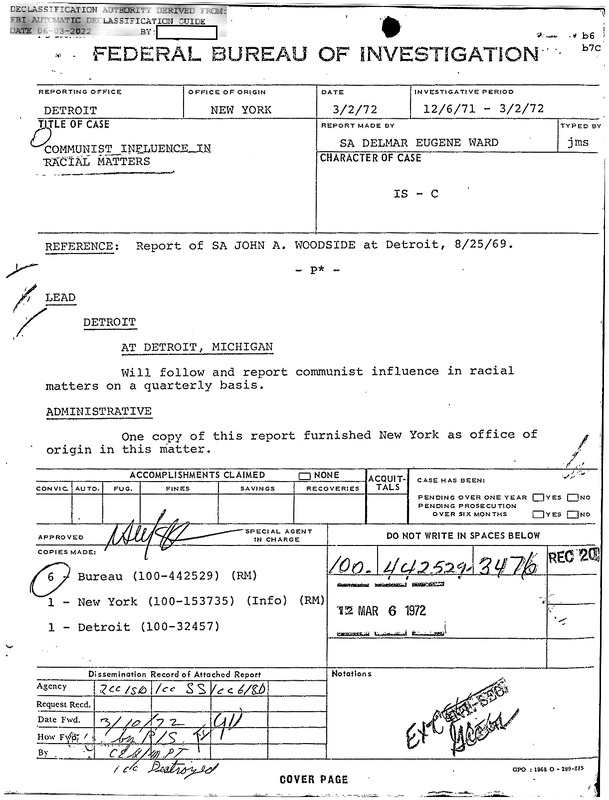
Sixteenth available report in a series on communist influence in civil rights activity in Detroit. Investigation occurred from December 1971 to March 1972. FBI describes the report as: “CPUSA (Communist Party of the United States), Michigan District of the Communist Party (MDCP), continues to maintain active interest in “Black Liberation Movement.” Recruitment of blacks is a major problem of MDCP. MDCP considering placing members near leaders of other organizations in an effort to influence them.”
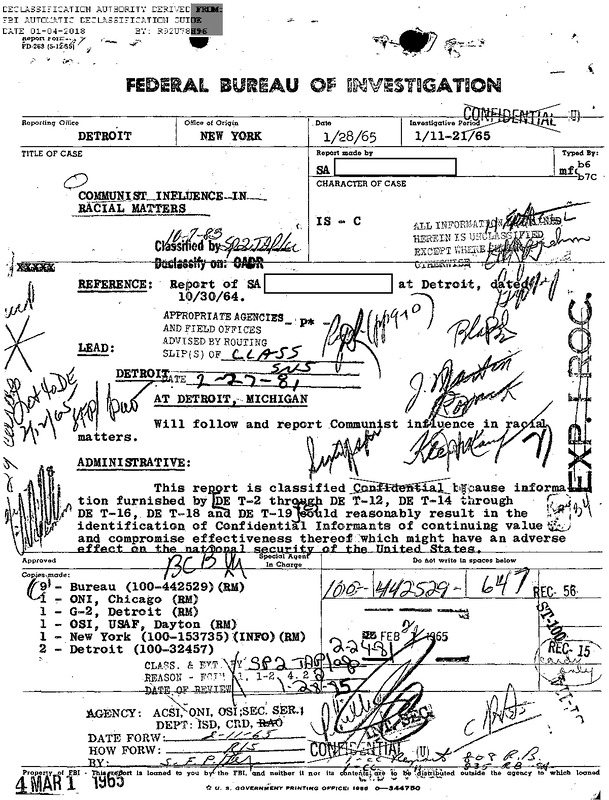
Second available report in a series on communist influence in civil rights activity in Detroit. Investigation occurred from January 11th to January 21st, 1965. FBI describes the report as: “Plans, strategy Party line and the like in Michigan, of the CP (Communist Party) and SWP (Socialist Workers Party) in racial matters, including a YSA (Young Socialist Alliance) and SWP sponsored demonstration, and the following organizations set forth: National Association for the Advancement of Colored People (NAACP), National Lawyers Guild (NLG), Negro-American Labor Council (NALC), Detroit Chapter, aka., Trade Union Leadership Council (TULC), and the Revolutionary Action Movement (RAM).”
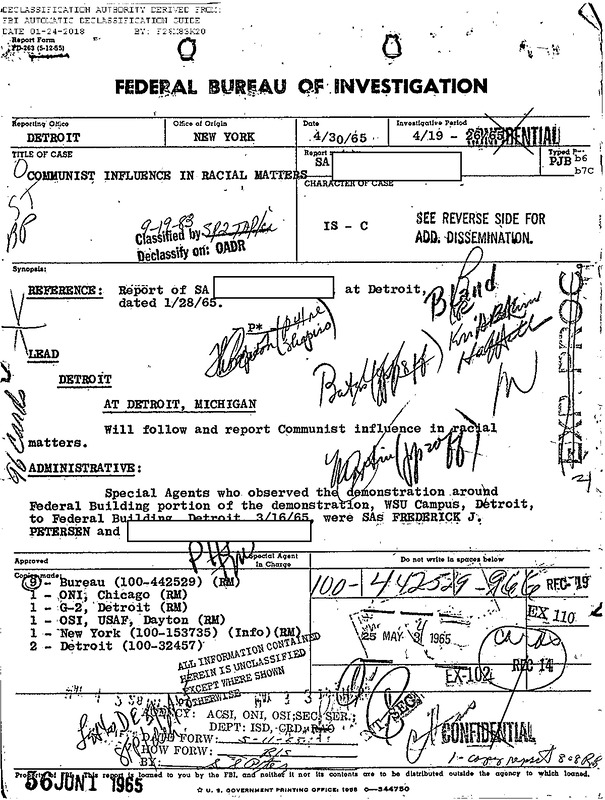
Third available report in a series on communist influence in civil rights activity in Detroit. Investigation occurred during April 1965. FBI describes the report as: “Plans, strategy Party line and the like in Michigan, of the CP (Communist Party) and SWP (Socialist Workers Party) in racial matters, including interest and activity in demonstrations and the following organizations, set forth: National Association for the Advancement of Colored People (NAACP), and the Metropolitan Detroit Labor and Community Association (MDLCA)."
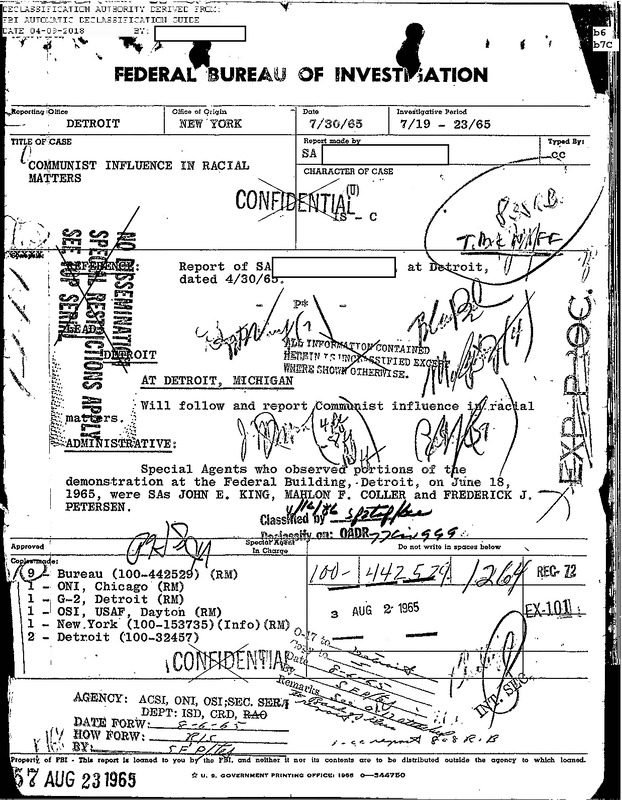
Fourth available report in a series on communist influence in civil rights activity in Detroit. Investigation occurred during April 1965. FBI describes the report as: “At a Michigan District Communist Party (MDCP) meeting on 5/3/65, Thomas Dennis, a CP functionary, said there are not many of "our" people active in mass work and that "we" are not doing anything in the civil rights struggle. Dennis directed the club representatives to go back to their clubs and have some serious political discussion on "Plan of Work". 'At a MDCP meeting on 6/8/65, Dennis said the MDCP has not yet decided on a course of action concerning the forthcoming Common Council election, City of Detroit. Dennis said it is his opinion the CP should observe who is the strongest Negro candidate, and help such candidate as much as possible. At a MDCP meeting on 6/22/65, Dennis berated the club members for not engaging in affairs of mass organizations. It was reported on 7/21/65, that the MDCP has done nothing in furtherance of placing its members and close sympathizers into the civil rights movement on into mass type organizations. At a Detroit Branch SWP (DBSWP) meeting on 4/27/65, it was stated that only one member belongs to CORE. Demonstration at Federal Building, Detroit, on 6/18/65; the “NLG 1965 Guild Program in the South for Desegregation of Public Facilities"; and plans of RAM, set forth."
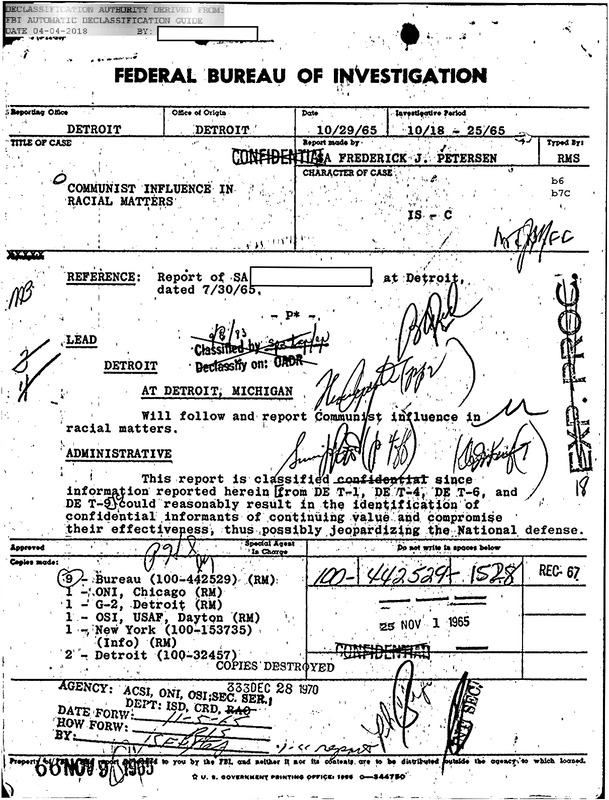
Fifth available report in a series on communist influence in civil rights activity in Detroit. Investigation occurred during October 1965. FBI describes the report as: “During 7/65 and 9/65, at meetings of Michigan District, CP (MDCP), SWP (Socialist Workers Party), and JFG (Johnson Forest Group), all in Detroit, Mich., involvement of Communists and others in racial matters, including MDCP and SWP support of Negro Candidates for Detroit Common Council, discussed. Recent SWP throwaway listed various events to be held in 7/65 and 8/65 at SWP headquarters in Detroit, featuring some racial topics. “Procedure and Check List for the 1965 Guild Program in Mississippi and the South for Desegregation of Public Facilities” sent to individuals on mailing list of NLG.”
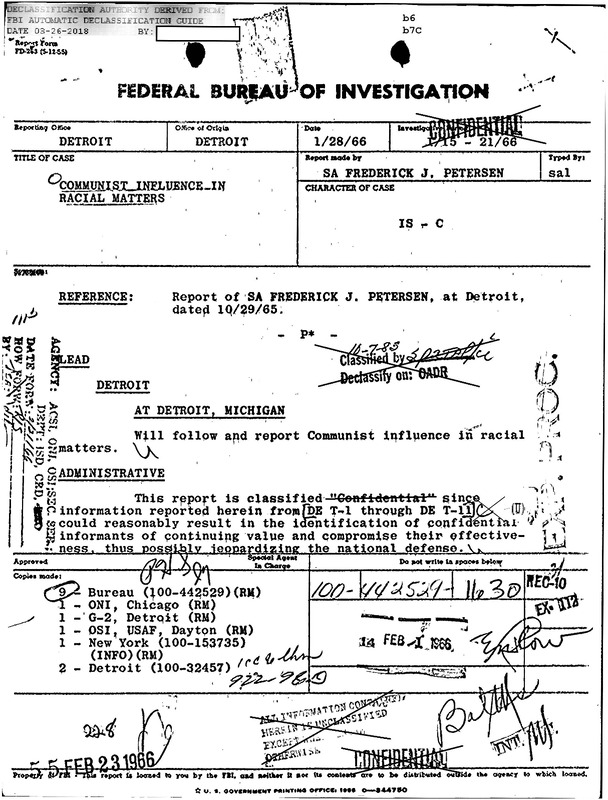
Sixth available report in a series on communist influence in civil rights activity in Detroit. Investigation occurred during January1966. FBI describes the report as: “Michigan District, CP (MDVP) educational class held Oct., 1965, regarding “Struggle for Negro Rights”, at Detroit. Discussion at some MDCP club meetings Nov. and Dec., 1965, concerned outcome of local city election with regard to Negro candidates, CP support for Negro leadership in UAW, and possible Party participation in “War on Poverty” program. Some members of News and Letters Committees (Johnson-Forest Group) participated in Congress of Racial Equality party and raffle held 12/17/65, at Detroit.” It is important to note that an investigation file targeted individuals that occured in 1959 at the end of the document.
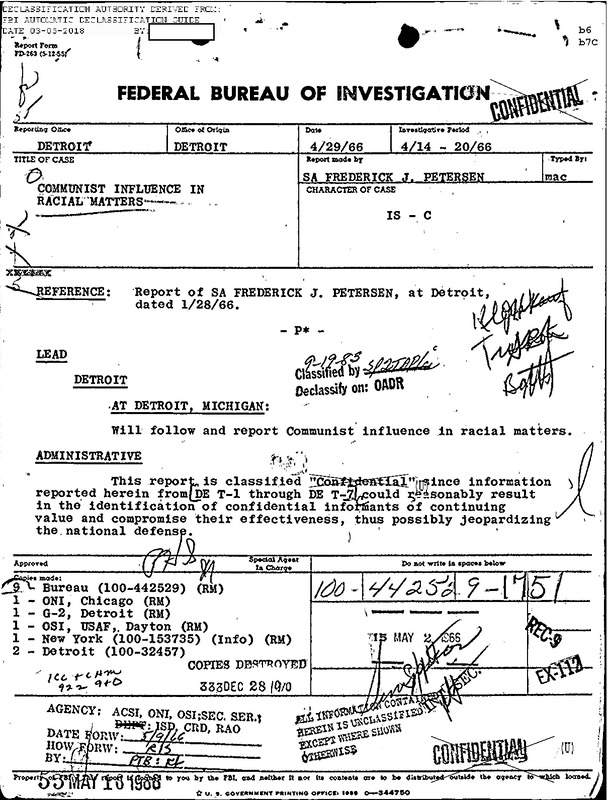
Seventh available report in a series on communist influence in civil rights activity in Detroit. Investigation occurred during April1966. FBI describes the report as: “Discussion led by Michigan District, CP leaders at local meetings criticized proposed “stop and frisk” law and concerned possible Negro candidates in forthcoming elections. Communist penetration of civil rights groups considered at 2/66 meeting of News and Letters Committees, Johnson-Forest Group, some members of whom were present at Congress of Racial Equality Rally held 2/4/66 at Detroit, Mich.”
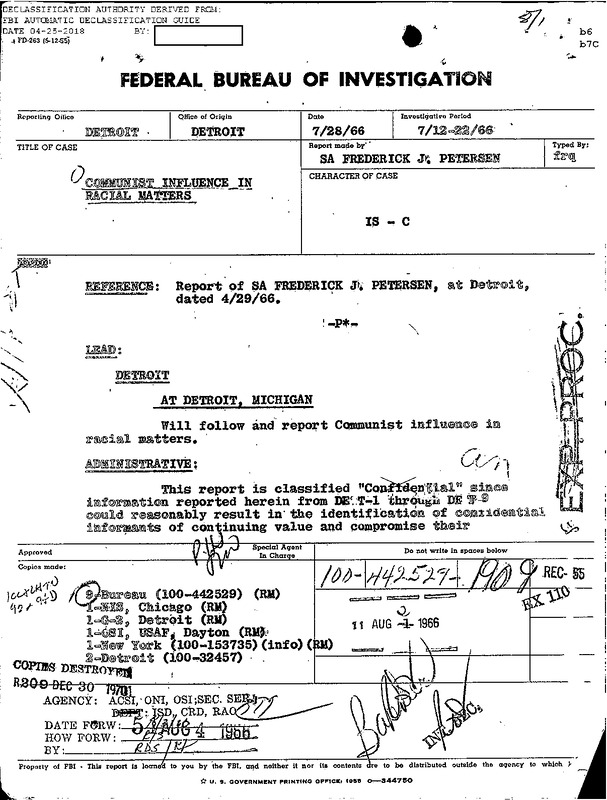
Eighth available report in a series on communist influence in civil rights activity in Detroit. Investigation occurred during July1966. FBI describes the report as: “Michigan District Communist Party (MDCP) leaders at recent local MDCP meetings discussed Communist Party (CP) involvement in Civil Rights and Racial activities and indicated CP will use attitude of opposition among whites and Negroes for its own work among Negroes. During April, 1966, several MDCP members participated in “Freedom School” which grew out of disturbances at predominately Negro high school in Detroit. On 6/24/66, members of News and Letters Committees, Johnson-Forest Group, were present at “Forum 66” meeting held in Detroit at which need for “Black Power” discussed."
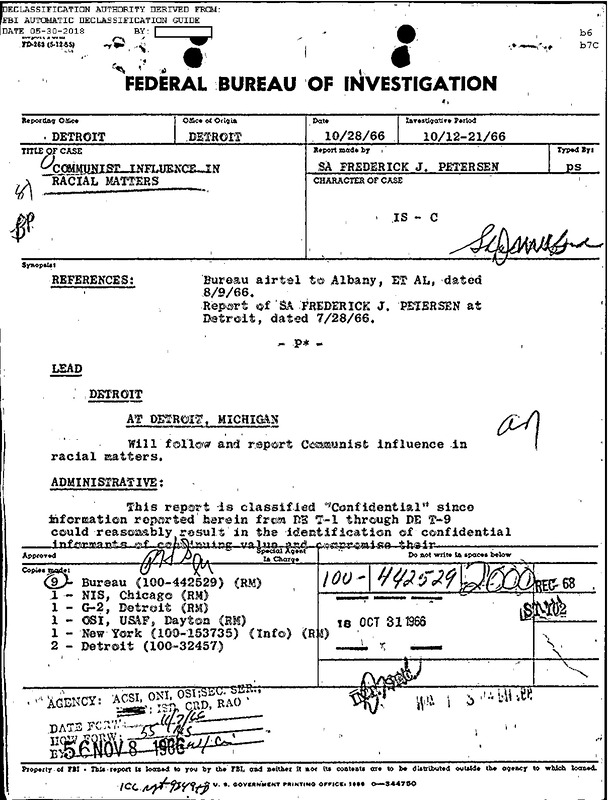
Ninth available report in a series on communist influence in civil rights activity in Detroit. Investigation occurred during October 1966. FBI describes the report as: “During July through September, 1966 at meetings of MDCP (Michigan District Communist Party) and JFG (Johnson-Forest Group) in Detroit, Mich., involvement of Communists and others in racial matters discussed. Report given by Thomas DeWitt Dennis, Jr., CP (Communist Party) national functionary, at MDCP meeting, regarding CP participation in National Leadership Committee for Debate on Foreign Policy held 9/10 – 11/66 in Cleveland, Ohio.”
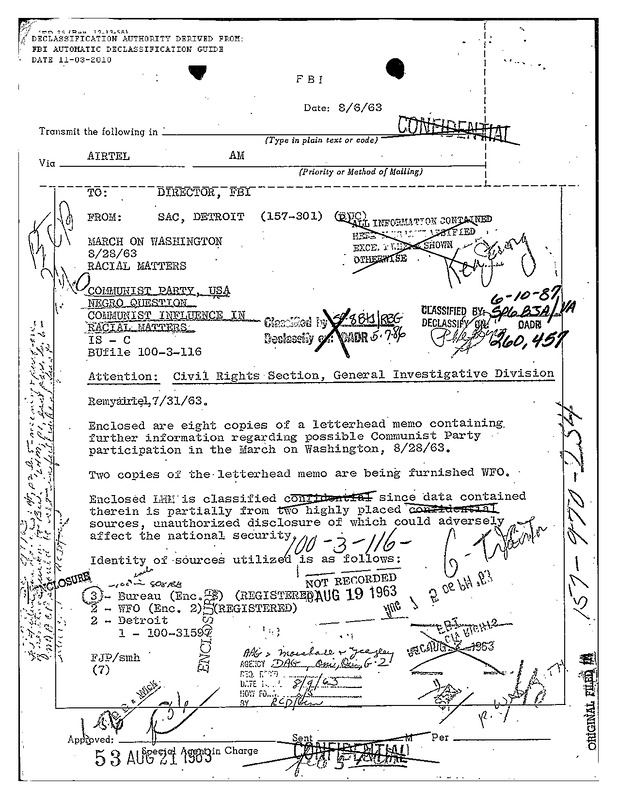
Investigation into communist activity in Detroit and regarding Carl Winter. Informants disclosed Winter’s discussion of the March on Washington at a local CPUSA meeting, and the CPUSA’s possible involvement and efforts to rally local labor leaders.
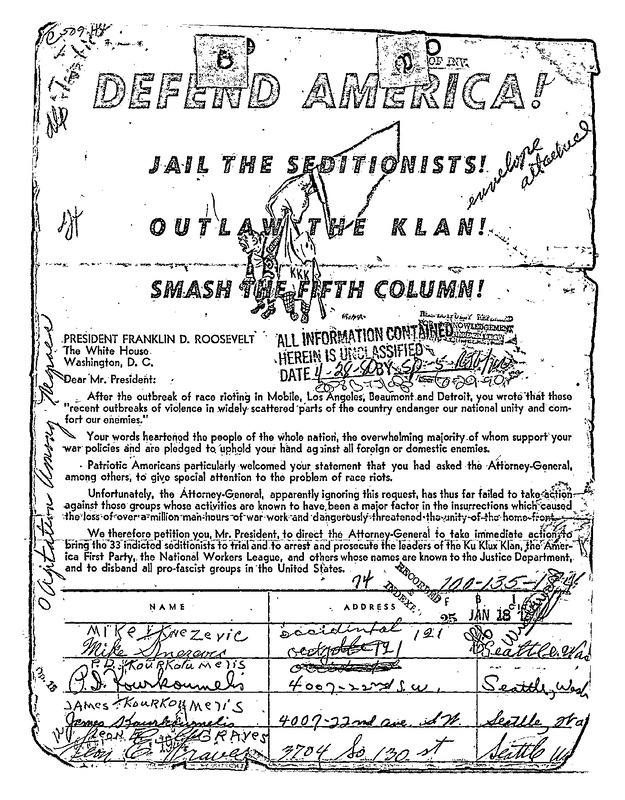
This is a signed letter sent to President Franklin D. Roosevelt calling for him, and the Attorney General, Francis Biddle, to take immediate action against indicted seditionists, leaders of the KKK, America First Party, and National Workers League, and all other pro-fascist groups.
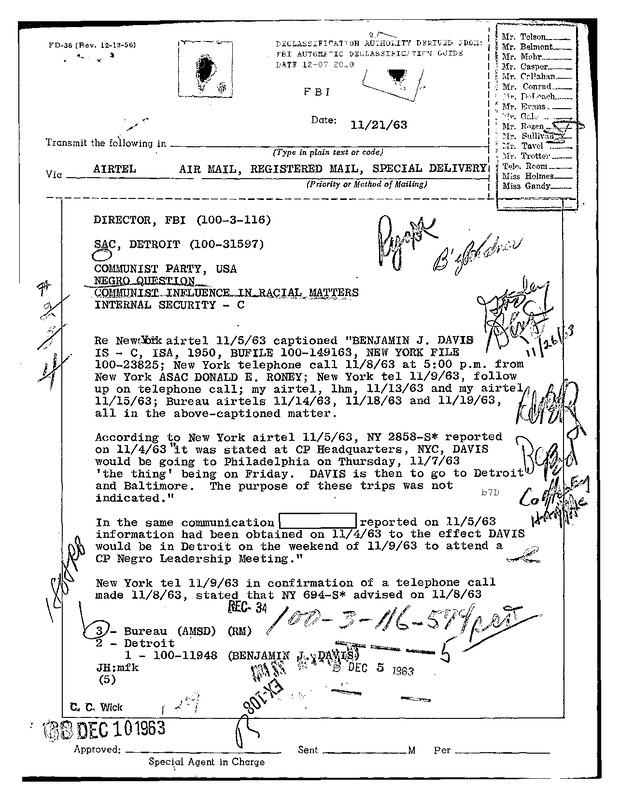
This memo is the Detroit FBI Field Office’s response to FBI headquarters’ critiques of its surveillance during Benjamin J. Davis’s November 8–10, 1963 visit. It provides a detailed account of surveillance activities, locations, and the information gathered on key Communist and Civil Rights leaders attending the Northern Negro Leadership Conference.
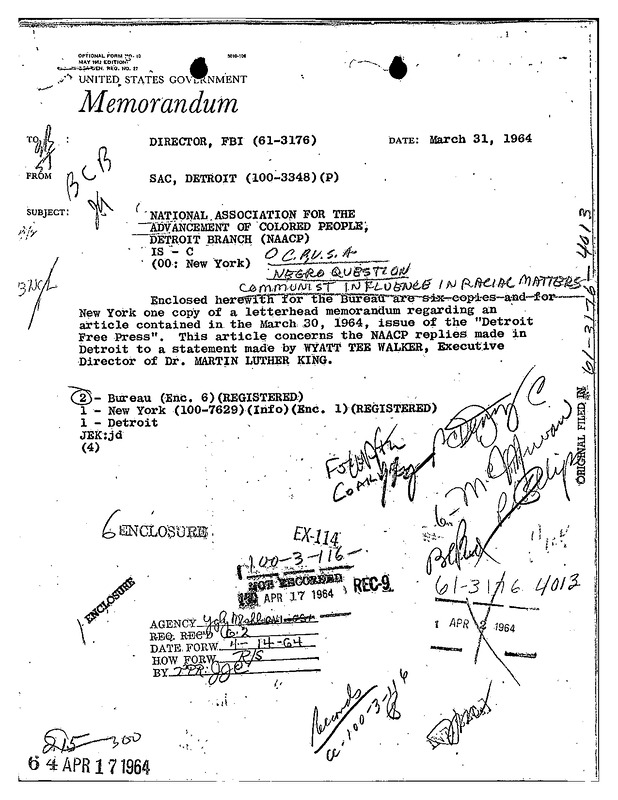
This memo discusses a Detroit Free Press article alleging internal tensions in the Civil Rights Movement. It documents the Detroit NAACP’s rebuttal to claims by Wyatt Tee Walker, Dr. MLK’s executive director, who accused them of capitulating to whites. The NAACP firmly denied the charge, calling it false and slanderous.
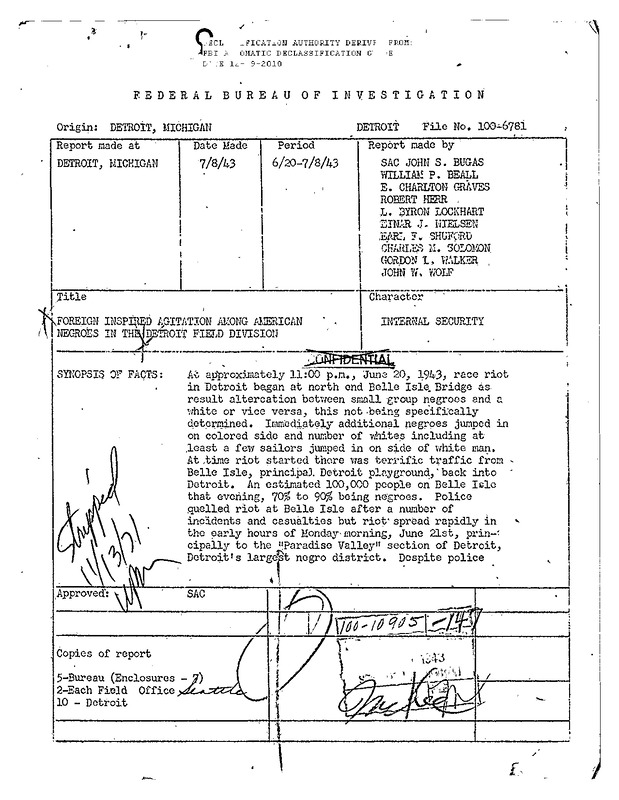
In-depth 103-page report discussing the Detroit Race Riot of 1943, the causes, the outcomes, the participants, and next steps, among other details. Coverage period is June 20th to July 8th, 1943. The FBI concluded that the riot was not planned by a specific group or person but was instead the result of several factors. They do warn that careful attention should be paid to communist influence in the Black community and its inflammatory tactics.
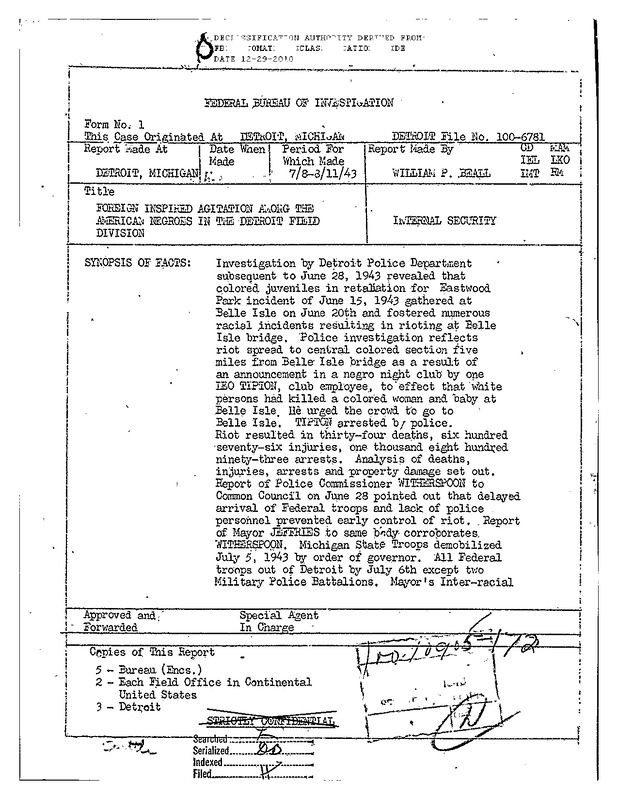
In-depth 133-page supplemental report discussing the Detroit Race Riot of 1943, the outcomes, and reports drafted by several agencies, both governmental and private-sector alike. Coverage period is July 8th to August 11th, 1943. It is important to note, despite repeated claims that foreign influences were meddling in the affairs of the Black community, hence triggering the race riot, the FBI found no evidence that any foreign power, particularly Axis powers, were involved in the riot.
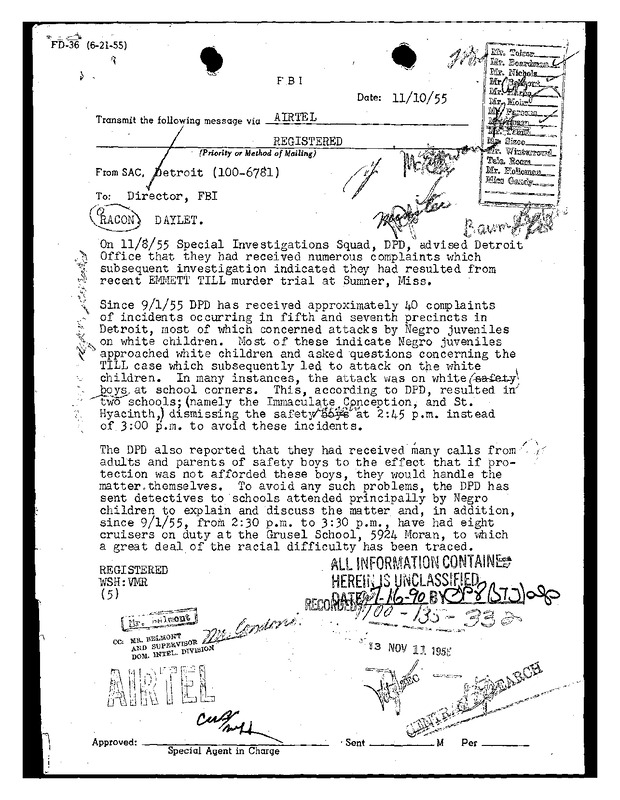
Memo discussing the situation in Detroit during the Emmet Till trial, in which Black children were supposedly attacking white children when asked about the trial. The Detroit Police Department was contacted and would be sending officers and cruisers to local schools to quell violence, as white parents said they would “handle the matter themselves” if the police did not intervene.
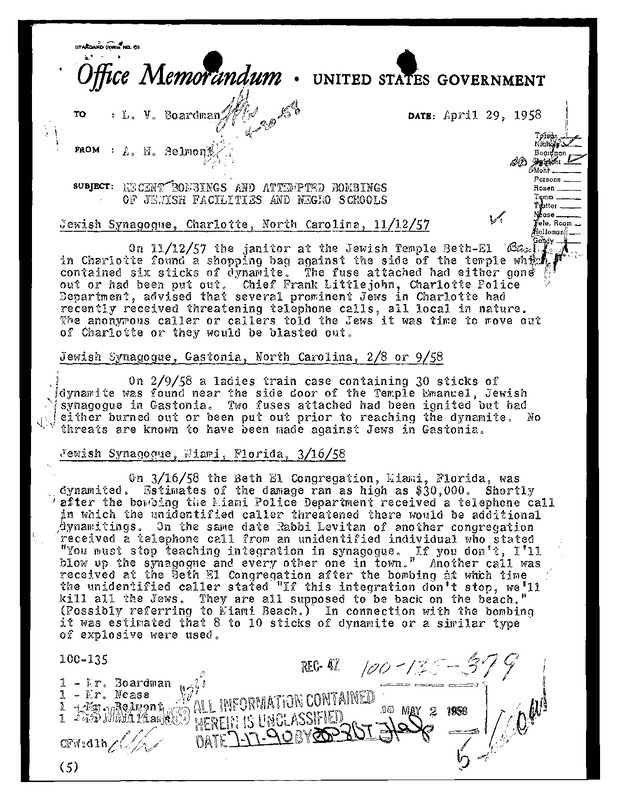
Series of communications regarding dynamite bombings of several Jewish facilities in South, perpetrated by the KKK. Document also includes newspaper clippings covering the incidents, letters from concerned community members, and a response from J. Edgar Hoover.
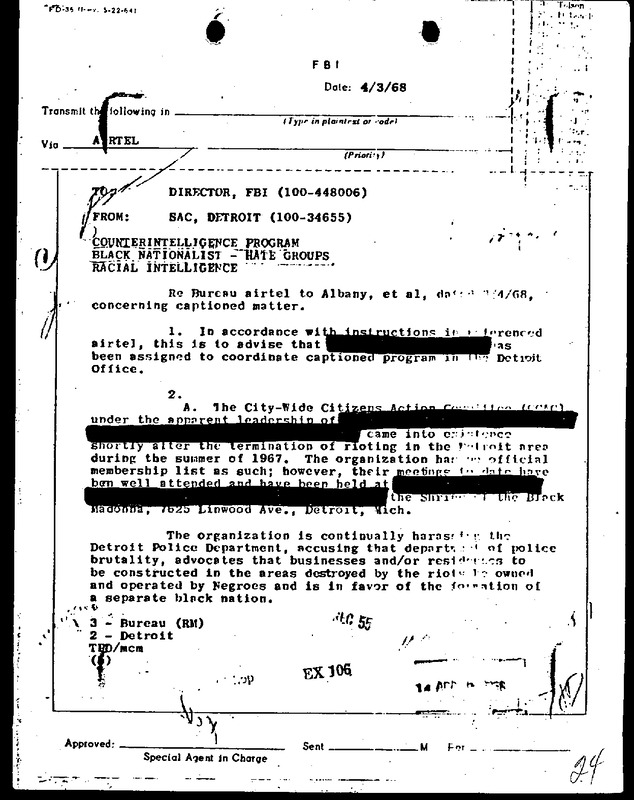
Racial Intelligence analysis of radical black nationalist groups in Detroit following the summer of 1967, such as the City-Wide Citizens action Committee (CCAC) and the Malcolm X. Society. All in regards to activism against police brutality, meeting attendance, purchases of firearms, and meeting dialogue of "establishing a separate black nation".
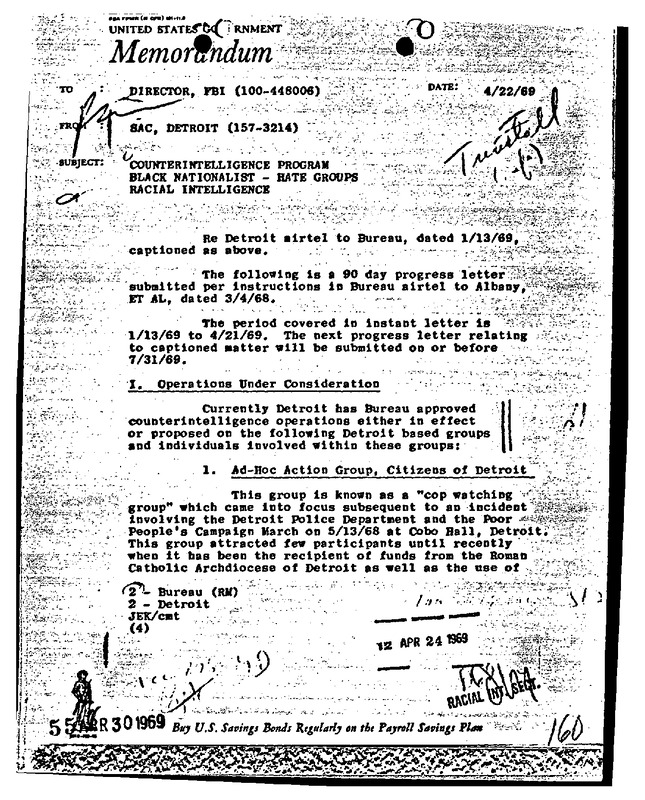
90-day progress report submitted to FBI Headquarters highlighting black nationalist groups, surveillance operations under consideration, ongoing operations, and the comprehensive tangible results produced.
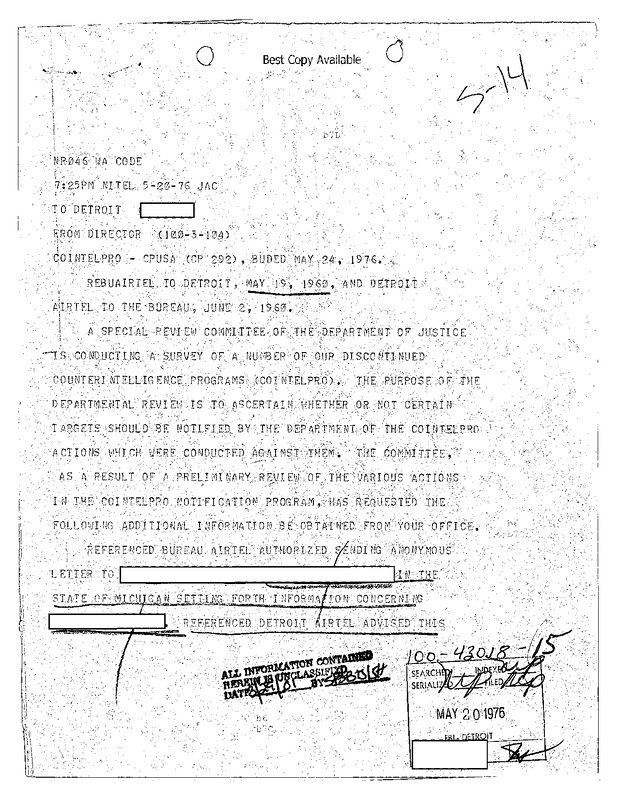
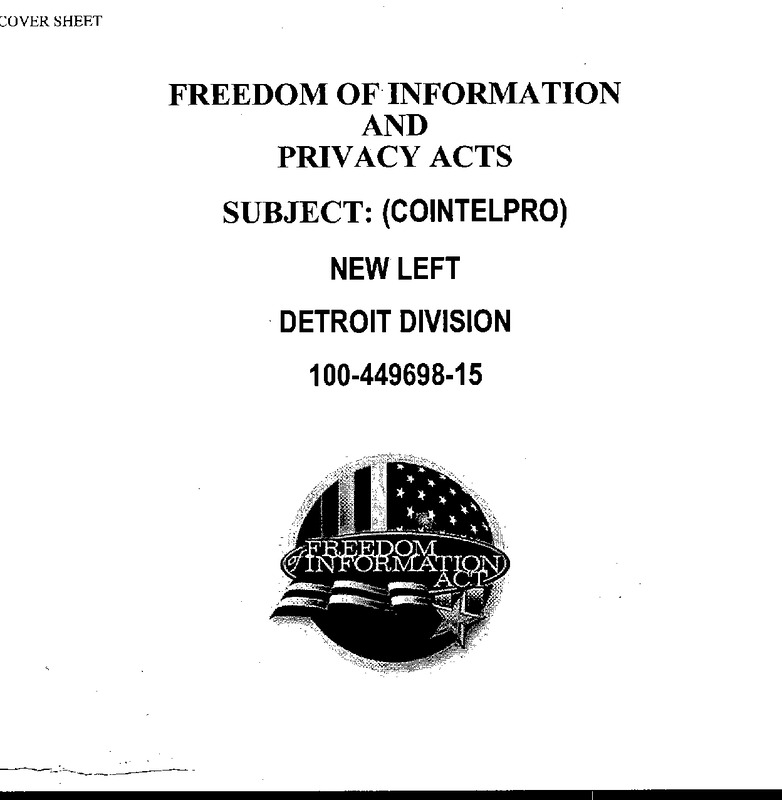
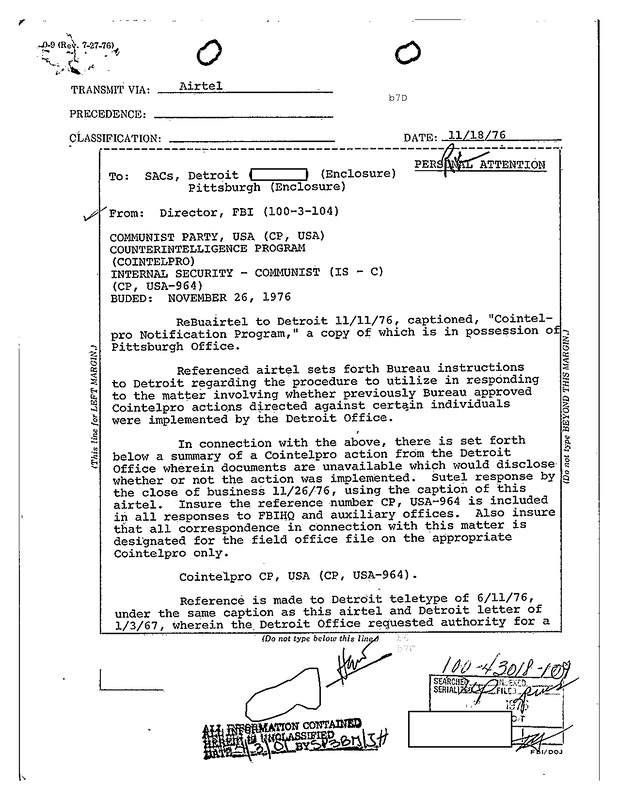
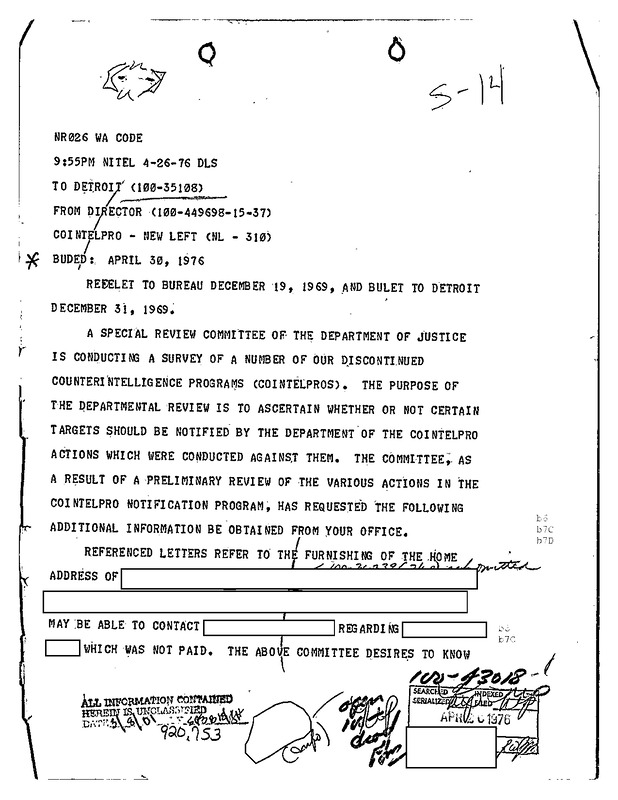
Hundreds of documents detailing counterintelligence methods used during COINTELPRO (1956–1971), with a focus on the Communist Party of the United States of America (CPUSA). Most are communications between the Detroit FBI Field Office and FBI Headquarters from May 1976- September 1977, when the DOJ conducted an internal review to determine “…whether or not certain targets should be notified by the department of the COINTELPRO actions which were conducted against them.” Tactics detailed include propaganda, smear campaigns, manipulation, and other efforts to infiltrate and destabilize the CPUSA and other leftist organizations. Several requested relevant documents are listed as "missing."
This document details a wide range of FBI counterintelligence tactics used against “New Left” activists in the Detroit metro, Ann Arbor, and at the University of Michigan. It describes efforts to disrupt groups like the Students for a Democratic Society (SDS), the White and Black Panther Parties, and the “Weather Underground”, among others, through anonymous letters, surveillance, and the exploitation of internal disputes and racial tensions. The document also outlines the Bureau’s coordination with local institutions, targeting of faculty and attorneys, and the use of fabricated information to intimidate or discredit individuals. These activities illustrate the extent and systematic nature of FBI operations against campus activism as revealed in this 184-page report.
206-page document outlining sustained counterintelligence efforts targeting New Left activists and organizations, particularly those associated with the Communist Party in the Detroit Metro. It details covert tactics such as sending fictitious anti-Communist letters to the media and employers, aimed at discrediting or costing individuals their jobs, as well as disrupting anti-war demonstrations and meetings. The document highlights operations against figures like Ernest Goodman, Claude Lightfoot, Judge George Crockett, and Reverend Albert Cleage, and records ongoing evaluations of past counterintelligence actions in the wake of COINTELPRO’s exposure. It also reveals internal discussions about the risks and ethical concerns of harassment, coordination with other FBI divisions, and attempts to sow distrust within targeted organizations. Documents are from November 1975 to September 1977, when the FBI began reviewing counterintelligence that took place between 1961 to 1969.
This 293-page FBI document primarily consists of internal communications following the exposure of COINTELPRO in the 1970s, as the Detroit Field Office and FBI headquarters attempted to locate files related to their counterintelligence operations against the New Left and Communist Party. Although the document lists names of targets and actions taken, it notes that most detailed records are either missing or unaccounted for. The correspondence reveals the Bureau’s efforts to reconstruct its past activities, contact affected individuals, and the widespread absence of critical documentation regarding this long standing operation.
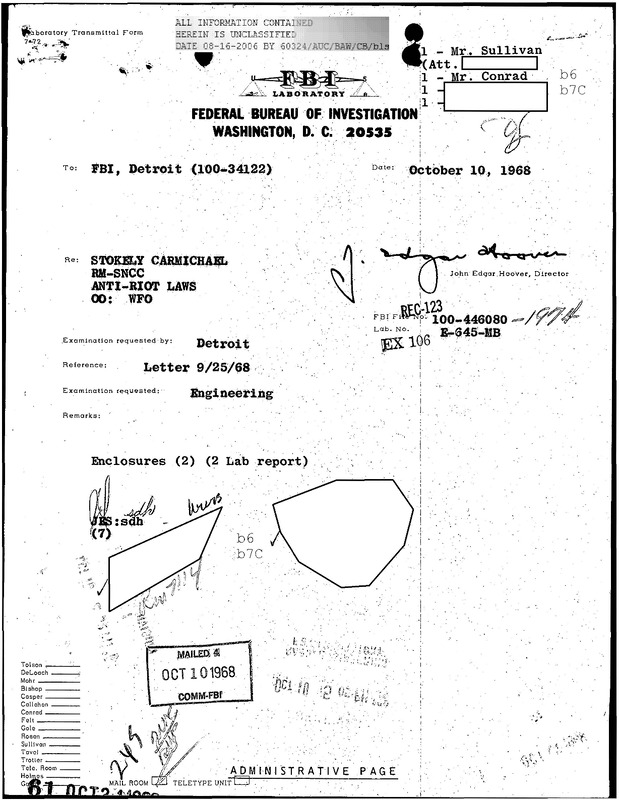
This document details the FBI’s attempt to identify additional attendees of Stokely Carmichael’s speech at the University of Michigan on August 22, 1968. Although an audio recording was made, tape distortions prevented full transcription, prompting the FBI director to request further field reports to reconstruct Carmel’s remarks. The tape’s contents are referenced but not included.
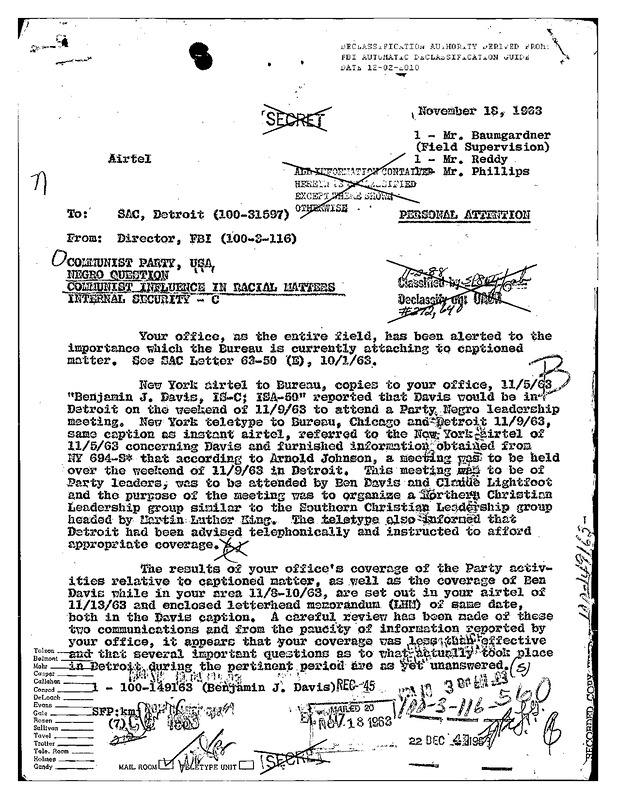
This memo from FBI headquarters sharply critiques the Detroit Field Office’s inadequate surveillance during Benjamin J. Davis’s November 8 –10, 1963 visit, despite significant resources assigned. The director requests a detailed explanation of planning procedures and operations within the Field Office to prevent future lapses in coverage.