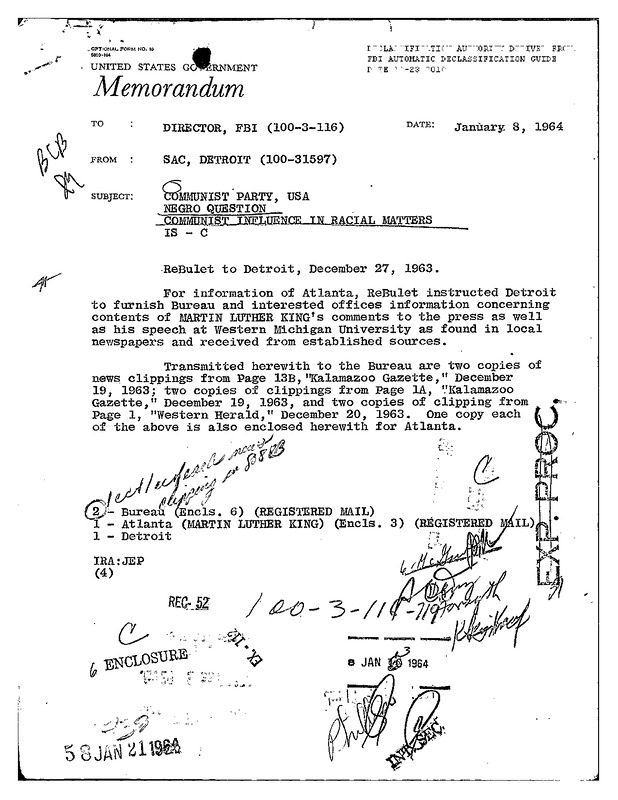
This document gathers newspaper articles reporting on Martin Luther King Jr.’s December 18, 1963 speech at Western Michigan University, which were forwarded to the Atlanta FBI Field Office as part of their ongoing investigation into MLK.
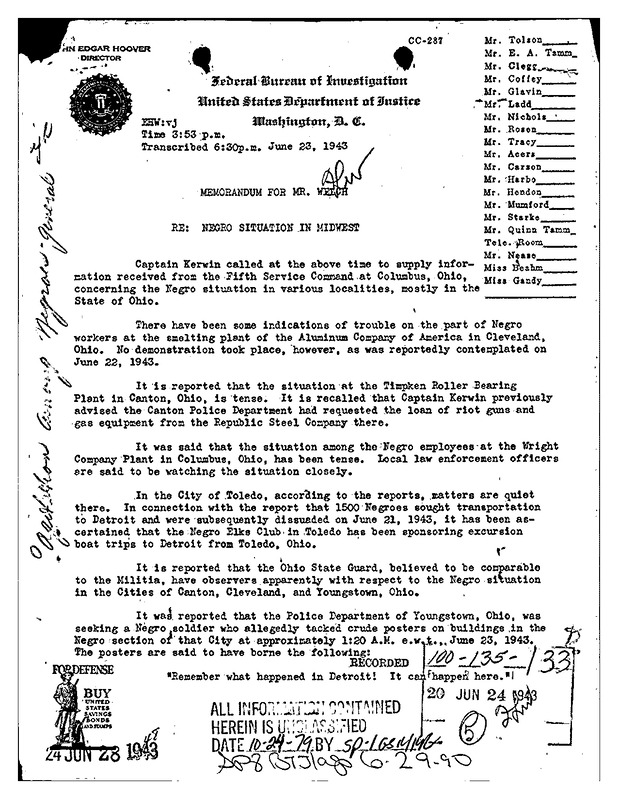
Summary of information disclosed by Captain Kerwin, U.S. Army, regarding unrest of Black communities across Ohio due to racism and discrimination. Kerwin disclosed information regarding employment and labor issues at civilian manufacturing plants and unrest amongst enlisted soldiers.
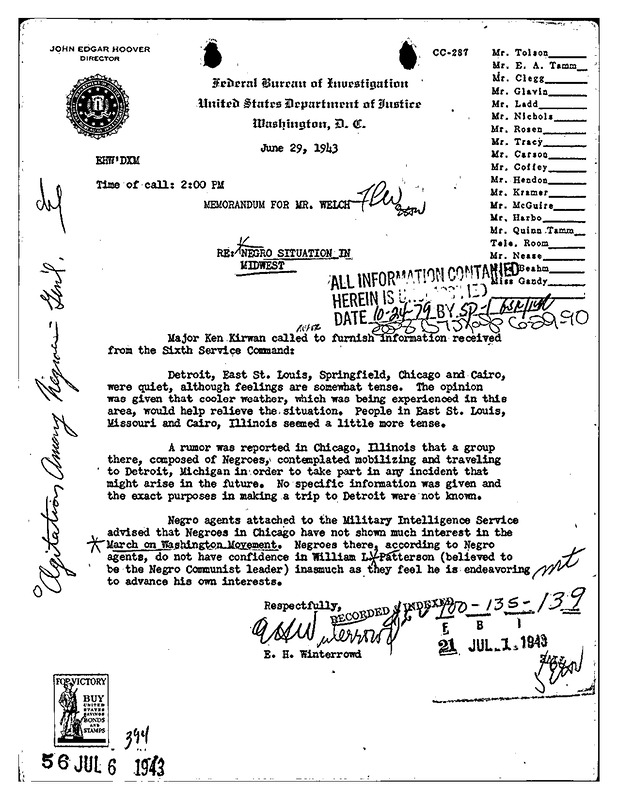
Follow-up summary from Major Ken Kirwan, U.S. Army, discussing possible demonstrations and unrest in the Midwest. Major Kirwan was an informant for the FBI. It is important to note, although this is listed alongside COINTELPRO files, this surveillance took place prior to formal initiation of COINTELPRO in 1956. The type of surveillance here is a precursor to the further expansion of mass surveillance activities throughout COINTELPRO.
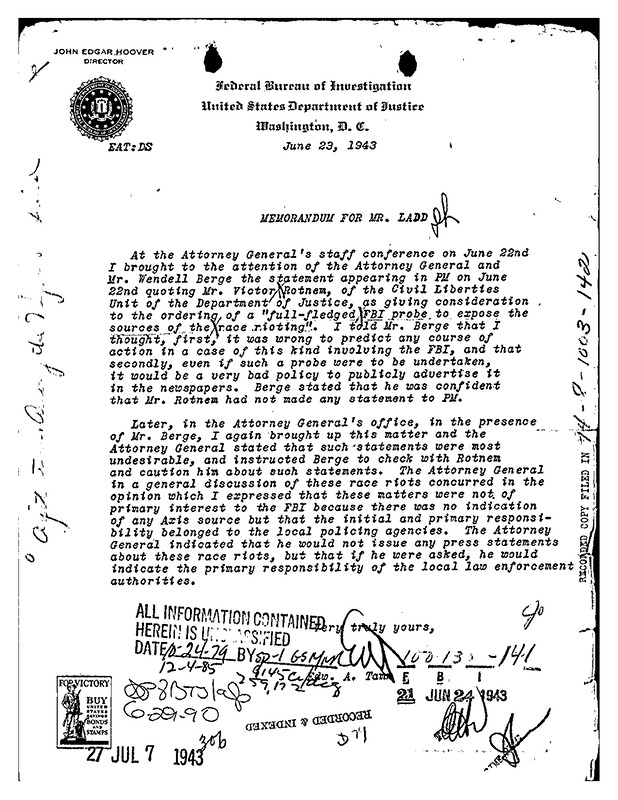
Internal memo to an assistant to J. Edgar Hoover, D.M. Ladd regarding Victor Rotnem’s, a member of the Department of Justice’s Civil Liberties Unit, being quoted in a newspaper stating that the FBI should order a “full-fledge probe to expose the sources” of race rioting in the United States. The memo writer had a conversation with the U.S. Attorney General about the danger of Rotnem’s statement. He believed that this would be bad publicity even if the FBI was involved in this kind of work, which the writer proclaimed was not happening. The memo writer also stated that the Attorney General was in agreement that this work was not in the primary interest to the FBI. This is contradictory to the surveillance and intelligence the FBI was conducting during this WWII time period. It is important to note, although this was claimed to be not in the interest in of the FBI, this type of surveillance did take place in subsequent years during the formalization of COINTELPRO.
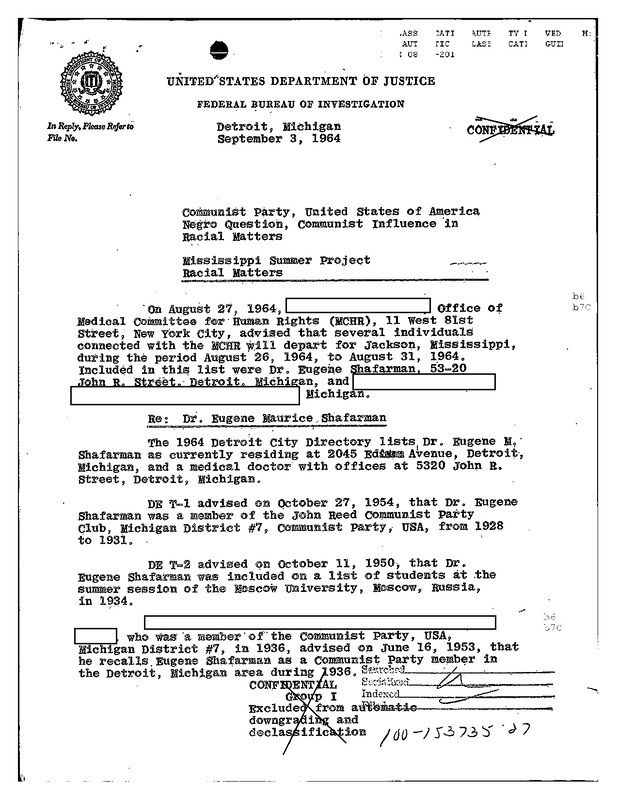
In depth profile and furnished informant details on individuals that participated, or were slated to participate, in the 1964 Mississippi Summer Project (Freedom Summer) and/or were alleged communists. Includes details about employment, travels, finances, as well as physical profiles of targeted individuals.
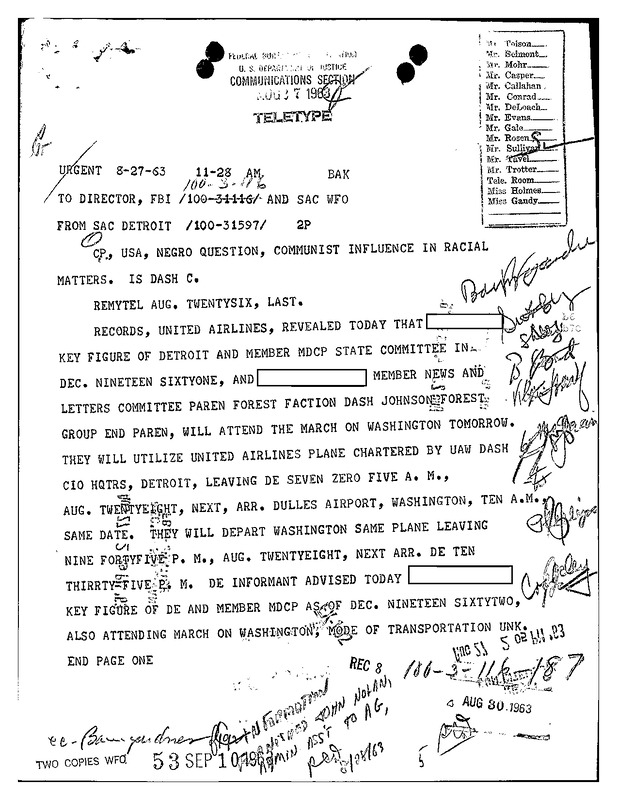
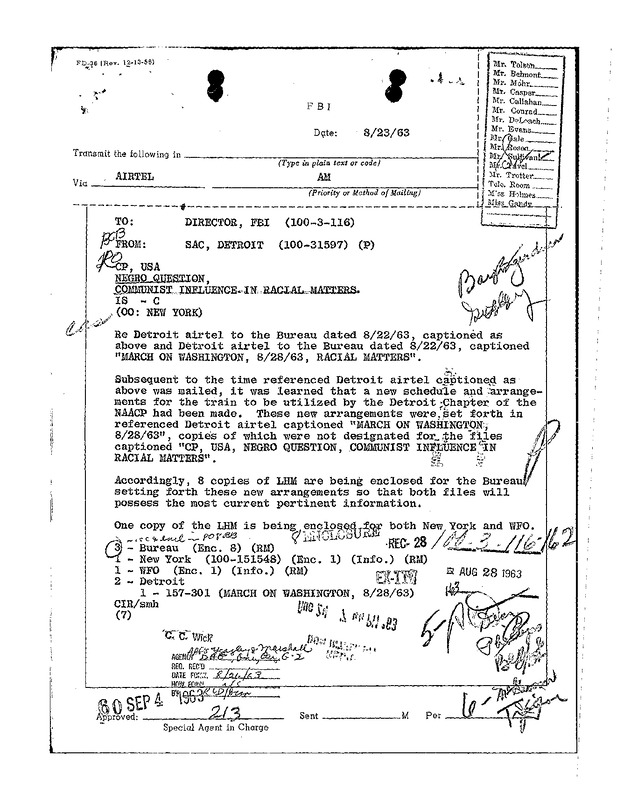
FBI gathered specific details regarding the train being serviced, departure & arrival dates, and the number of tickets purchased by the Detroit NAACP for locals to attend the March on Washington on August 28th, 1963.
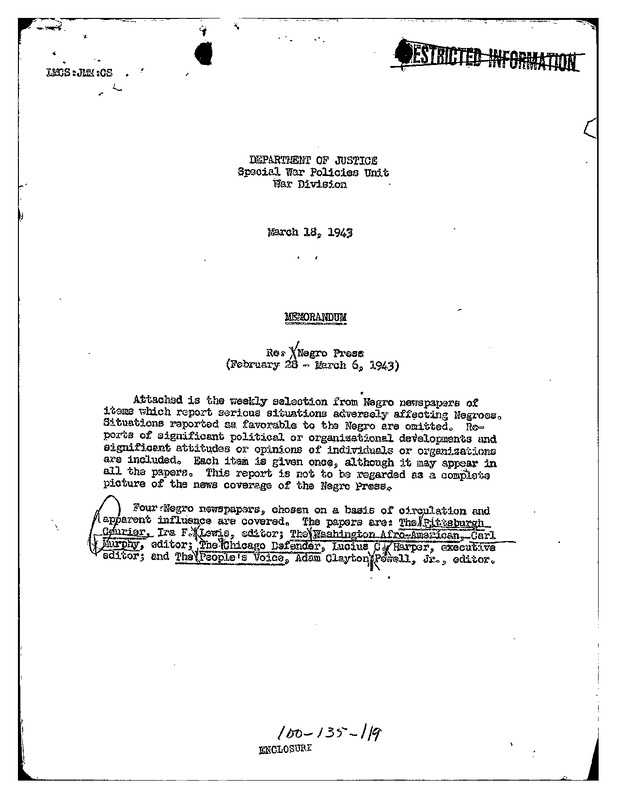
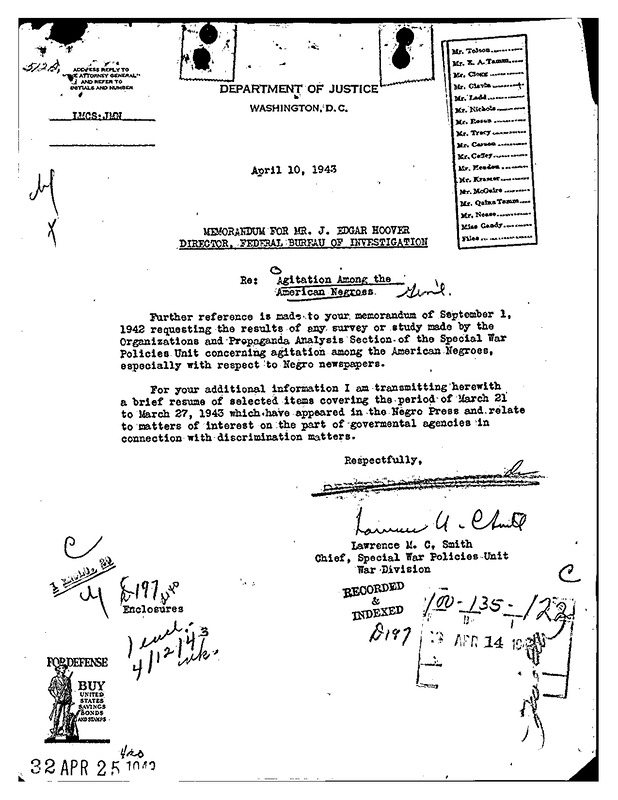
A memo containing a collection of quotes from Black publications from the week of February 28th, 1943. These memos were distributed internally and documented “serious situations adversely affecting Negroes” These memos were drafted to support the FBI’s Survey of Racial Conditions (RACON) regarding racial unrest and agitation. Pages and quotes included in this selection of pages highlight discrimination in the Armed Forces and employment. It is important to note, although this is listed alongside COINTELPRO files, this surveillance took place prior to formal initiation of COINTELPRO in 1956. The type of surveillance here is a precursor to the further expansion of mass surveillance activities throughout COINTELPRO.
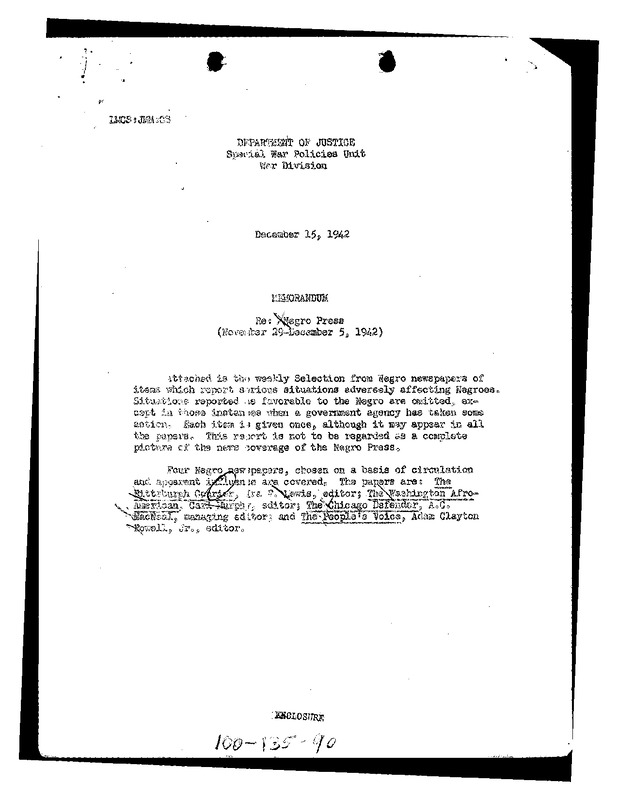
A memo containing a collection of quotes from Black publications from the week of November 29th, 1942. These memos were distributed internally and documented “serious situations adversely affecting Negroes” These memos were drafted to support the FBI’s Survey of Racial Conditions (RACON) regarding racial unrest and agitation. Pages and quotes included in this selection of pages highlight discrimination in the Armed Forces and employment. It is important to note, although this is listed alongside COINTELPRO files, this surveillance took place prior to formal initiation of COINTELPRO in 1956. The type of surveillance here is a precursor to the further expansion of mass surveillance activities throughout COINTELPRO.
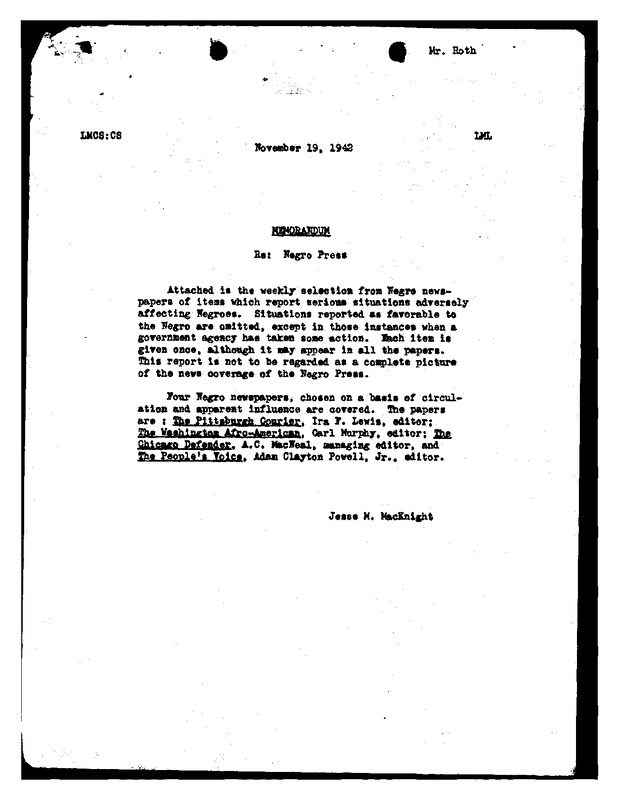
A memo containing a collection of quotes from Black publications from the week of November 8th, 1942. These memos were distributed internally and documented “serious situations adversely affecting Negroes” These memos were drafted to support the FBI’s Survey of Racial Conditions (RACON) regarding racial unrest and agitation. It is important to note, although this is listed alongside COINTELPRO files, this surveillance took place prior to formal initiation of COINTELPRO in 1956. The type of surveillance here is a precursor to the further expansion of mass surveillance activities throughout COINTELPRO.
A memo containing a collection of quotes from Black publications from the week of February 28th, 1943. These memos were distributed internally and documented “serious situations adversely affecting Negroes” These memos were drafted to support the FBI’s Survey of Racial Conditions (RACON) regarding racial unrest and agitation. Pages and quotes included in this selection of pages highlight discrimination in the Armed Forces and employment. It is important to note, although this is listed alongside COINTELPRO files, this surveillance took place prior to formal initiation of COINTELPRO in 1956. The type of surveillance here is a precursor to the further expansion of mass surveillance activities throughout COINTELPRO.
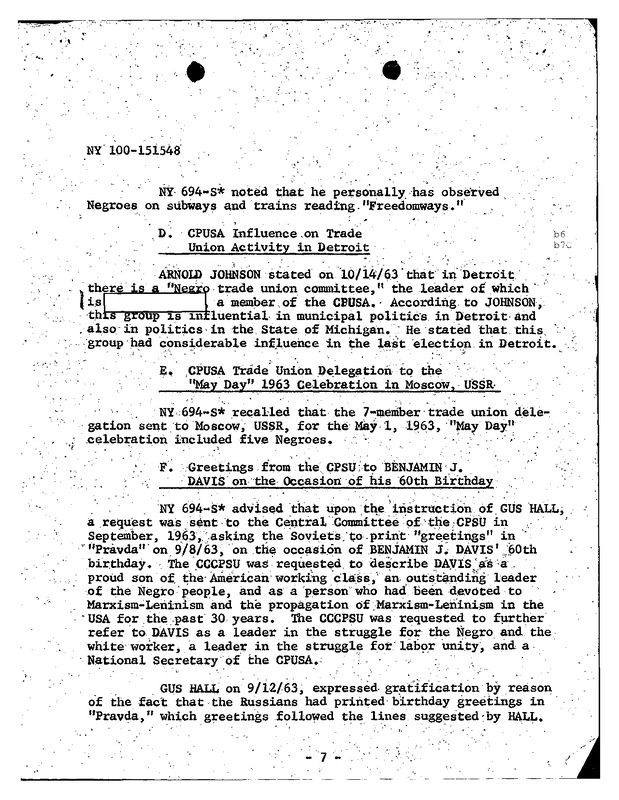
This document briefly discusses Arnold Johnson’s remarks on the influential Negro Trade Union Committee in Detroit politics. It also notes that the CPUSA contacted the Soviet CPSU to have Pravda publicize Benjamin J. Davis’s birthday and recognize his leadership in labor unity and Black struggles.
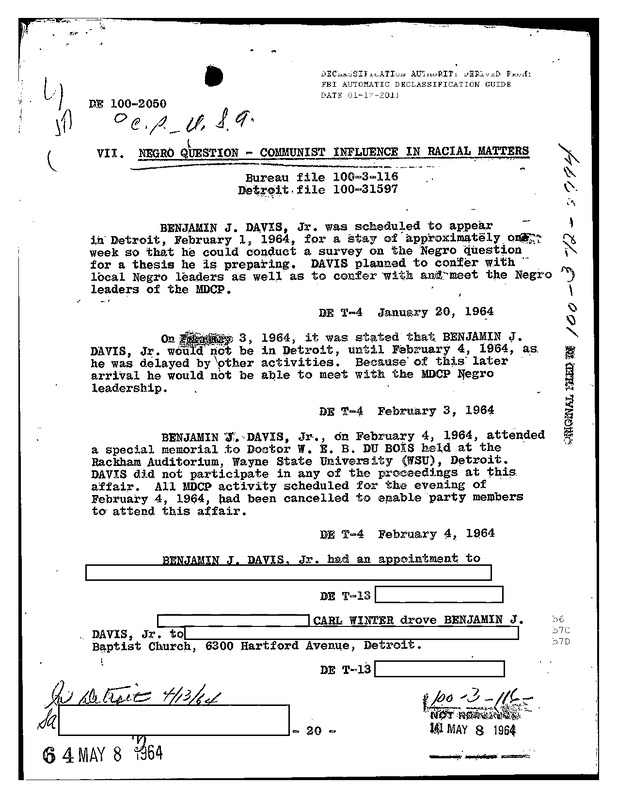
This document details sustained FBI surveillance of Benjamin J. Davis in Detroit during January and February 1964, alongside monitoring of Communist Party meetings focused on racial tensions, the civil rights movement, and the party’s involvement in these issues.
The FBI sent a panel of clergymen, social workers, and businessmen (all of whom are white) from across the United States a list of questions foll Detroit and Harlem pertaining to recent race riots. These questions were interested in what locals were saying about the race riots, were tensions increasing or decreasing, and what steps should be taken to avert future race riots. Several points were made by the panel of correspondents, stating that causes of racial tensions are largely attributed to discrimination, poor living conditions, and “extremist” agitators. Solutions listed were centered around removal of discrimination, improved conditions, and education, while others stated that Black folks should be “kept in his place” and segregation rigidly enforced.
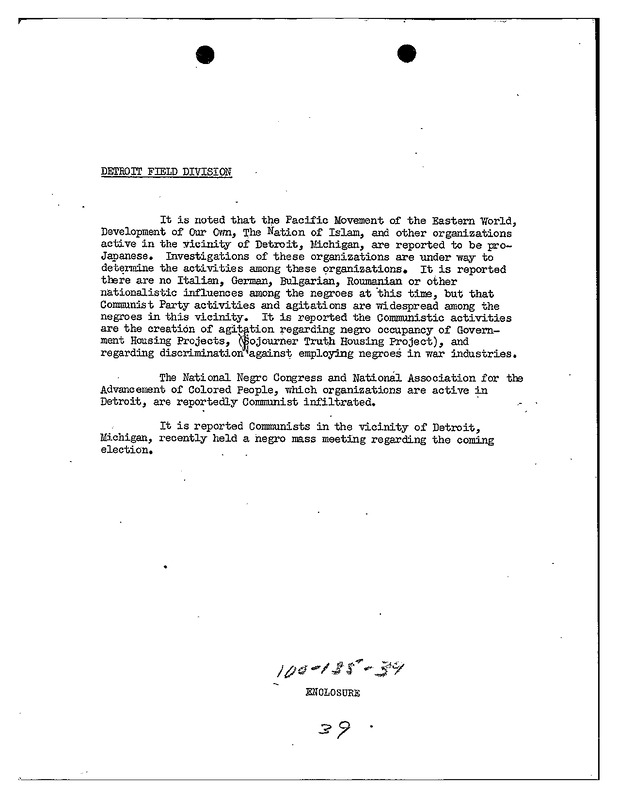
Brief note regarding the suspected pro-Japanese stances of Black communities and the influence of communism in said communities during WWII. Organizations under surveillance include the NAACP, The Nation of Islam, The Pacific Movement of the Eastern World, and Development of Our Own, among others, in the Detroit area. It is important to note, although this is listed alongside COINTELPRO files, this surveillance took place prior to formal intimation of COINTELPRO in 1956. The type of surveillance here is a precursor to the further expansion of mass surveillance activities throughout COINTELPRO.
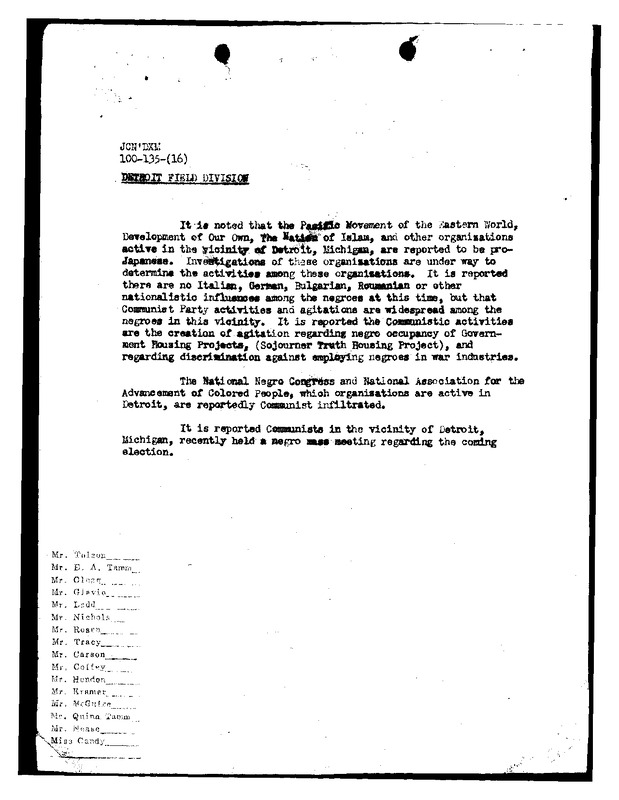
This is a duplicate of Pro-Japanese Stances and Communist Influences in Black Detroit #1, but it includes the FBI’s file number. Brief regarding the suspected pro-Japanese stances of Black communities and the influence of communism in said communities during WWII. Organizations under surveillance include the NAACP, The Nation of Islam, The Pacific Movement of the Eastern World, and Development of Our Own, among others, in the Detroit area. It is important to note, although this is listed alongside COINTELPRO files, this surveillance took place prior to formal initiation of COINTELPRO in 1956. The type of surveillance here is a precursor to the further expansion of mass surveillance activities throughout COINTELPRO.
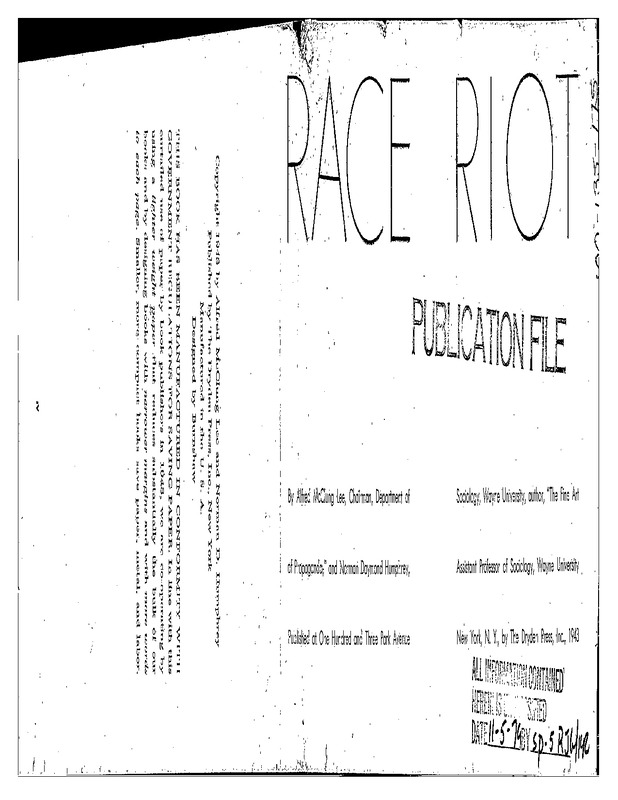
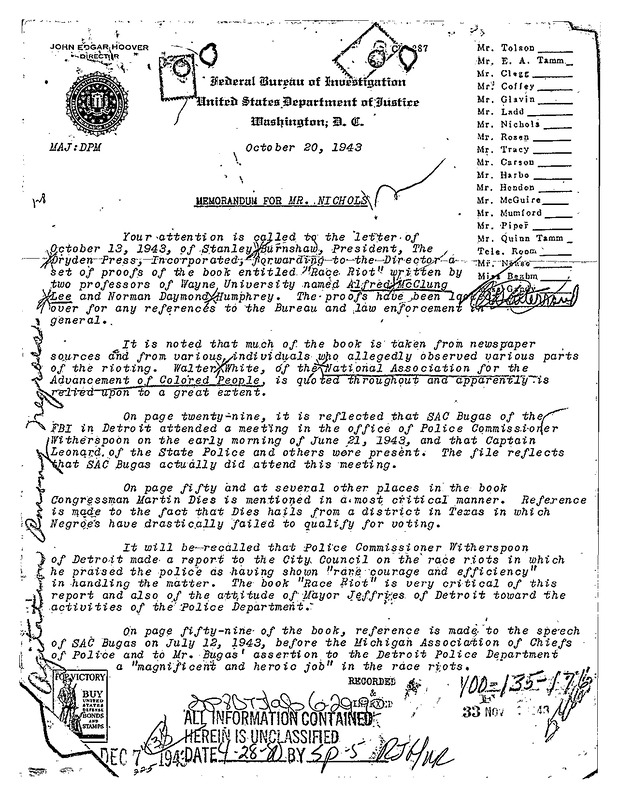
A full scanned copy of Alfred Lee and Daymond Humphrey’s book detailing the Detroit Race Riot and its causes in 1943. Details overcrowding, police brutality, and systematic oppression as catalysts for conflicts. Several annotations throughout this scanned copy which relate to interests of the FBI.
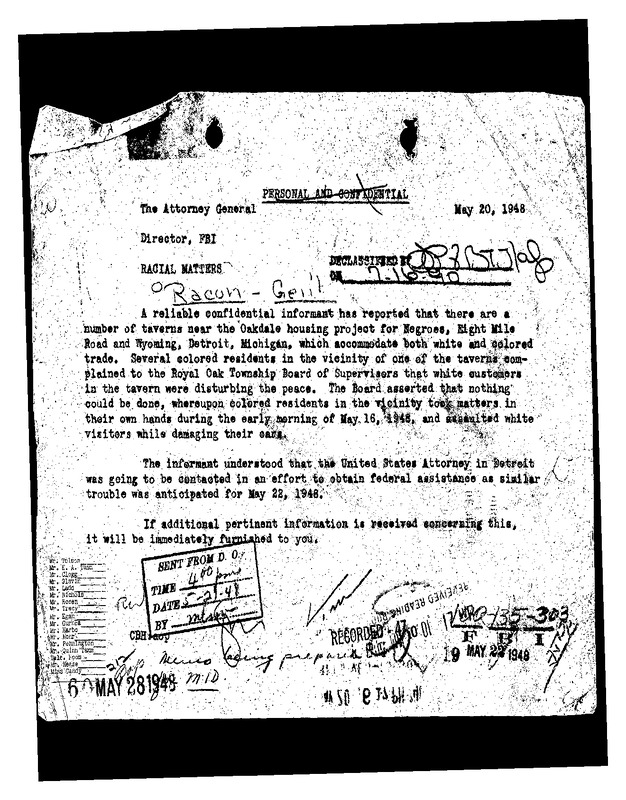
Brief memo from FBI Director, J. Edgar Hoover, to U.S. Attorney General, Francis Biddle, seeking additional information on racial disturbances in Royal Oak. A confidential informant had disclosed that white patrons were disturbing Black patrons at a local tavern, and that the District Attorney General was going to be contacted, with federal assistance being sought at a later date, if things were not resolved. It is improtant to note that the use of informants in this instance preceeded the formalization of COINTELPRO, which didn't occur until 1956.
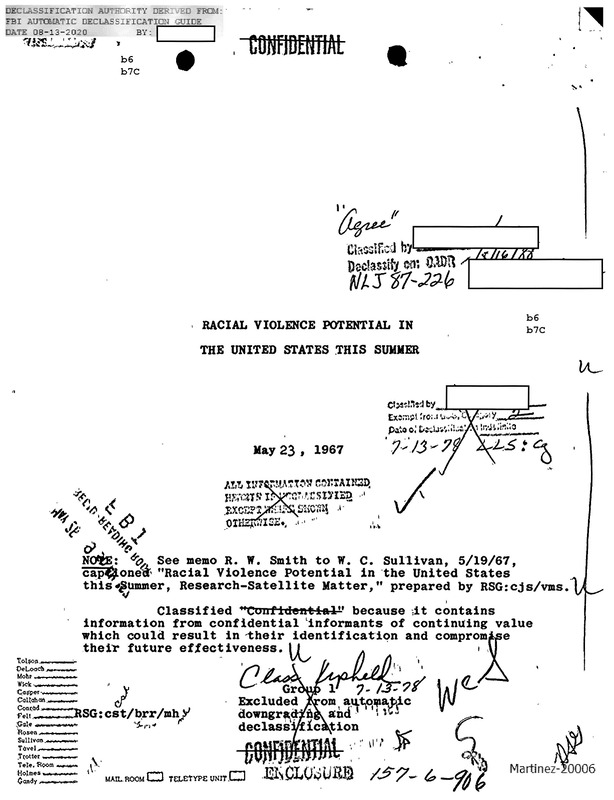
This self-described "intelligence survey" assesses the likelihood of racial violence in major U.S. cities during the summer of 1967, drawing on information from public officials, law enforcement, informants, and FBI agents. The report provides a thorough analysis of conditions in cities across all regions, including the connection to the anti-war movement, and evaluates each location’s climate and risk based on collected data.
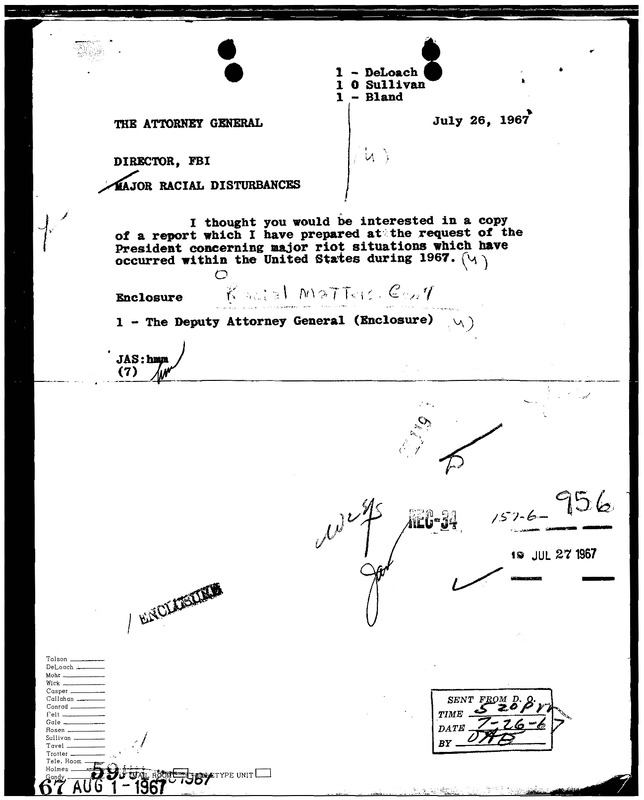
This report, prepared for the President and FBI Director J. Edgar Hoover, details racial disturbances and riots in 20 U.S. regions from April to July 1967. Drawing information from public and official sources, the report examines the role of major figures such as Stokely Carmichael, Martin Luther King Jr., and H. Rap Brown, identifying them as catalysts for the Black Power movement and anti-war activism. It provides in-depth analysis of each region’s unrest and explores the underlying causes as interpreted by the FBI.
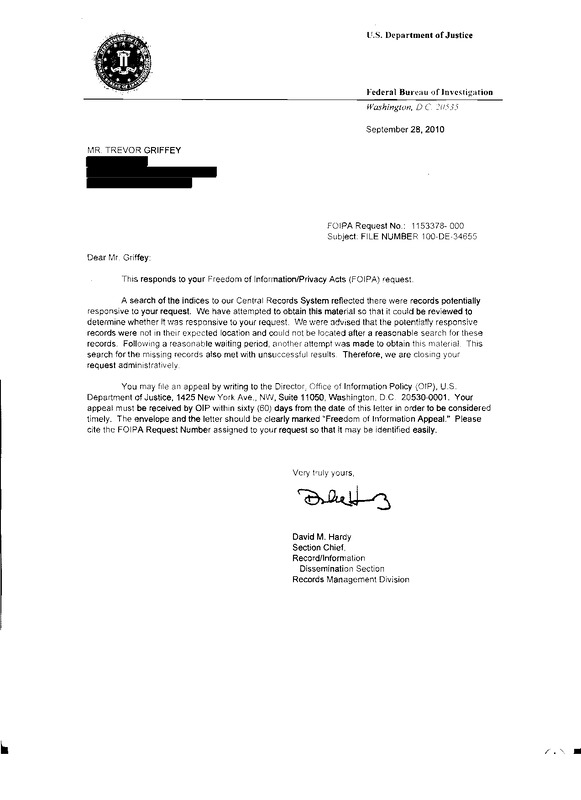
A response from David Hardy, Chief of the FBI's Record Information/Dissemination Section, stating that records requested via the Freedom of Information/Privacy Acts (FOIPA) by a Mr. Trevor Griffey are "missing." These requested documents highlighted the COINTELPRO tactics used against Black Nationalist Groups in Detroit. While classified as "missing", portions of these requested documents can be found in this database listed under FBI COINTELPRO - Black Nationalist Targets & Tactics in Detroit Metro (1).
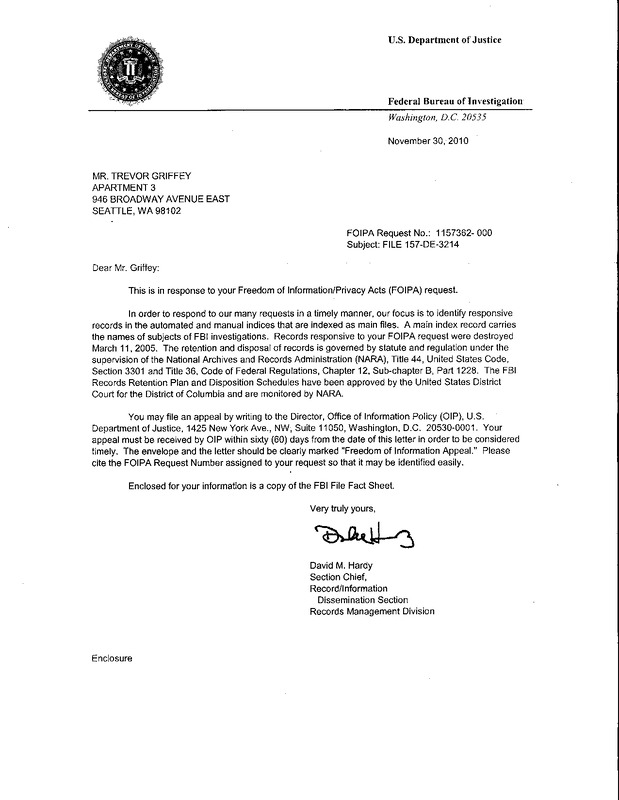
A response from David Hardy, Chief of the FBI's Record Information/Dissemination Section, stating that records requested via the Freedom of Information/Privacy Acts (FOIPA) by a Mr. Trevor Griffey have been "destroyed” as of March 11, 2005. These requested documents highlighted the COINTELPRO tactics used against Black Nationalist Groups in Detroit. While classified as "destroyed", portions of these requested documents can be found in this database listed under FBI COINTELPRO - Black Nationalist Targets & Tactics in Detroit Metro (2).
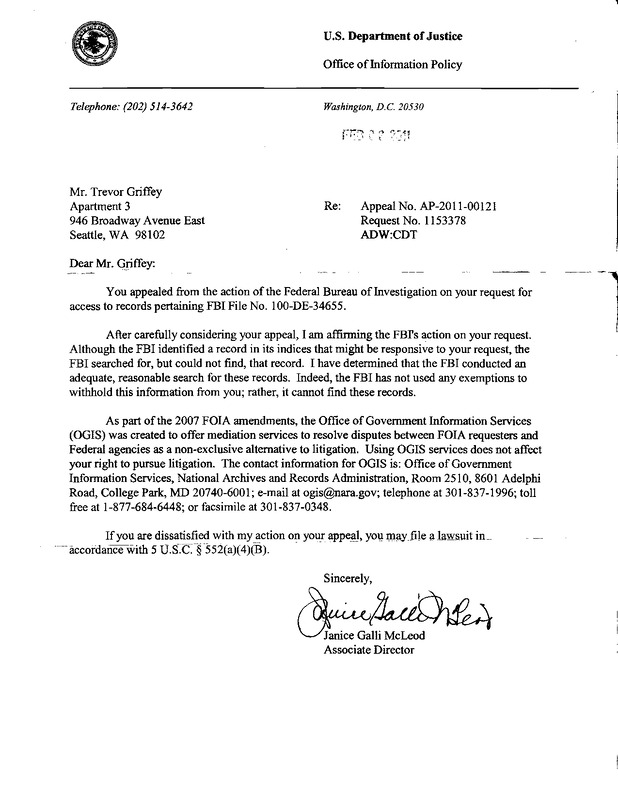
A rejected Freedom of Information Act (FOIA) appeal from Janice McLeod, Associate Director of the DOJ's Office of Information Policy. The letter states that requested COINTELPRO documents on Black Nationalists in Detroit were not located, and an adequate and reasonable search for those records was conducted. The FBI's the consensus is that the files are "missing". Portions of these requested documents can be found in this database listed under FBI COINTELPRO - Black Nationalist Targets & Tactics in Detroit Metro (1).
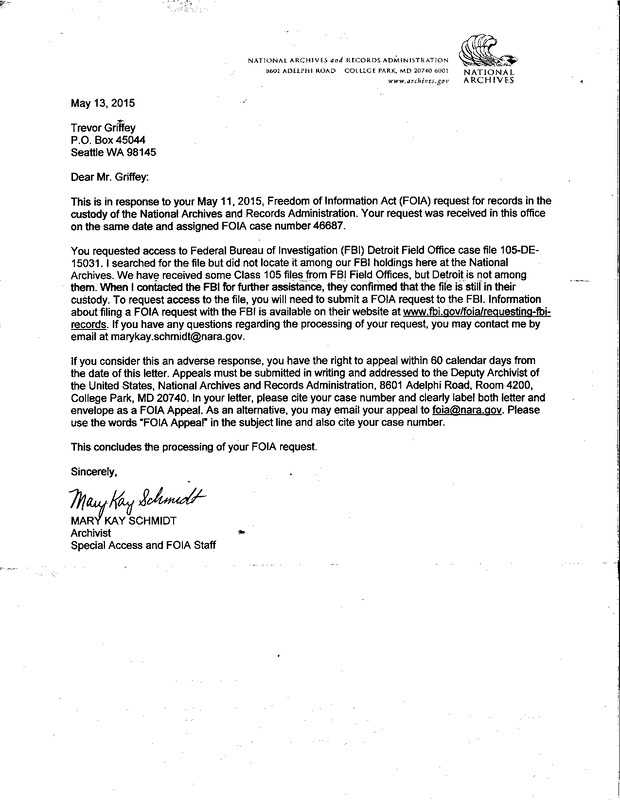
Response from NARA stating that requested COINTELPRO documents on The New Left in Detroit Metro were actually in the FBI's possession, and lack thereof in their holdings.
The first half of this document consists of internal discussions within the FBI regarding the book Race Riot written by Alfred Lee & Norman Humphrey. References to the FBI and FBI interests within the book are listed throughout the memo. A suggestion of sending a letter to the publisher, who was asking for the FBI’s comment on the book, declining reaction was put forth. The second half of this document is a letter written by an Alabama resident that there is foreign influence in the Black community, hence repeated race riots. The writer also makes several claims that Black folk are not the equals of whites and should be put in their place, something that the U.S. Government, and the FBI, should play a role in.