MI-CURE News (August 2014) covering collateral consequences of criminal records and NACDL recommendations; critiques of the Justice Reinvestment Initiative; updates on a lawsuit over MDOC dental care; details on an advocacy event for sentencing reform; Michigan’s problem-solving courts and recidivism statistics; policy changes regarding birth certificates and law library access; and news on efforts to expand Medicaid enrollment for parolees.
MI-CURE News (August 2015) covering MDOC programming and reentry; member surveys on employment, idle time, and access to educational/vocational programs; findings on the impact of prison education on recidivism and employment; suggestions for sentencing reform, habitual offender laws, and fair parole practices; analysis of prison wages and proposals for a livable income or reduced commissary costs; updates on litigation concerning inadequate dental care in prison; and legislative efforts to restore Pell Grants and implement presumptive parole.
MI-CURE News (August 2016) covering expanded Pell Grant access at Michigan prisons; critical analysis of residency restrictions for sex offenders; updates on Taser misuse; DOJ lawsuit against MDOC over discriminatory staffing at women’s facilities; promotion of holistic defense models and licensing reform; Obama Administration’s Fair Chance hiring and education initiatives; critiques of felony-murder laws; and advocacy for safe housing for transgender prisoners.
MI-CURE News (August 2017) covering the need for expanded use of commutations; legal updates on Does v. Snyder and sex offender registry reform; federal court decision weakening FCC regulation of prison phone rates; national efforts to overhaul cash bail systems; backlash against DOJ’s dismantling of forensic science standards; new support models for reentry, including housing-first and employment training programs; critique of exploitative prison wages; and Supreme Court ruling on social media access for registrants.
MI-CURE News (August 2018) covering the Does v. Snyder II class action challenging Michigan’s sex offender registry; guidance for registrants on legal compliance and advocacy; updates on higher education access in Michigan prisons and the positive impact of arts programs; innovations in reentry support, including VR training and pretrial representation; national criminal justice reform efforts like ending user fees, second-look sentencing, and new probation models; and local, faith-based alternatives to policing—all promoting fairer, evidence-based justice systems.
MI-CURE News (August 2019) covering advocacy for ending life and excessive sentences; Michigan’s new licensing initiative for returning citizens; trauma-informed court practices and the movement to end prison gerrymandering; critical reassessments of life without parole, video hearings, and the decline of jury trials; updates on Does v. Snyder, diversion programs, and compassionate release legislation; innovative hiring models removing barriers for people with records; and wide-ranging reforms across the U.S. on charging practices, misdemeanor ethics, sentencing for abuse survivors, and more—advancing justice that is equitable, humane, and evidence-based.
MI-CURE News (August 2020) covering efforts to ban involuntary servitude and pay living wages in prison; campaign to end solitary confinement; expanded voting rights for incarcerated and returning citizens; national calls for criminal justice, sentencing, and policing reform; prison education initiatives; community-based alternatives to incarceration; COVID-19-driven decarceration and probation changes; continued advocacy for free or affordable prison communication; reentry support programs and job training; wrongful conviction review expansion; and rise of progressive prosecutor coalitions.
MI-CURE News (August 2021) covering Michigan prison food reform and transparency efforts; reinstatement of Pell Grants; COVID and justice-impacted resources; drug and dental care crises in prisons; solitary confinement reform; new prosecutor accountability tools; reformist prosecutors and sentencing policy; reforms on free prison calls, gender identity housing, deceptive interrogations, and youth incarceration; and educational and civic achievements by incarcerated individuals.
MI-CURE News (August 2022) covering investigations into Arizona’s prison labor system and national prison labor reform; storytelling projects highlighting incarcerated voices; continued solitary confinement reform; innovative prison education and rehabilitation programs; MDOC staffing shortages and pay increases; updates on Michigan’s sex offender registry litigation; settlement reforming cash bail practices; and nationwide updates on jury service rights, prison conditions, voting access, behavioral health units, community reintegration, federal judicial appointments, trans healthcare, prison medical care lawsuits, and solitary confinement limits.
MI-CURE News (August 2023) covering innovative prison programming in education and arts; expanded Pell Grant access and data on educational impact; prison food and commissary cost concerns; prison phone cost reductions and free call legislation; national effort to end the trial penalty; Michigan indigent defense funding debates; legislative efforts on second look sentencing, bail reform, and good time credits; voting rights for incarcerated people; solitary confinement abolition efforts; and expanded reentry supports including IDs and Medicaid access.
MI-CURE News (August 2024) covering innovative prison programming including Restoring Promise units, jail animal farms, and mobile welding training; FCC action to reduce prison phone and video call costs; litigation updates on sex offender registry limits, forced prison labor, lifetime monitoring, and no-parole sentencing; state and federal legislation on medical parole, informant use, trial rights, and prison oversight; reentry efforts including Medicaid pilots, housing access, small business loans, and financial coaching; voting rights expansion and challenges to prison gerrymandering; and growing recognition of defense attorneys’ role in post-sentencing advocacy.
MI-CURE News (February 1991) covering efforts to establish Citizen Advisory Boards; promote incarceration alternatives; advocate for parole reform; research pre-release programs; oppose a female boot camp in Kalamazoo; and challenge restrictive visitation policies.
MI-CURE News (February 1992) covering a shift in priorities to parole reform and post-release support; collaboration with the Department of Mental Health; membership expansion; rising parole violations and prison growth; opposition to Pell Grant restrictions; and advocacy for a rehabilitative justice system.
MI-CURE News (February 1993) covering the upcoming advocacy-focused membership meeting; prison visitation review; ride-share initiative; rule changes and felony murder reform; membership expansion; available publications; and a national GAO study on elderly incarceration costs.
MI-CURE News (February 1994) covering parole guideline hearings; critiques of sentencing criteria and therapy availability; lifer public hearings and advocacy; treatment program backlogs; new legislation allowing inmate phone wiretapping; governor’s sentencing reform proposals; efforts against FOIA restrictions on inmates; and MDOC mailing issues.
MI-CURE News (February 1995) covering expansion of prisons and the financial impact; advocacy against mass incarceration and harsh sentencing policies; priorities for parole reform and treatment access; updates on felony murder legislation; concerns over prison telecommunications and visitation restrictions; and efforts to support families of incarcerated individuals.
MI-CURE News (February 1996) covering MDOC’s intrusive visitor search policy; restrictive parole guidelines limiting rehabilitation; Governor Engler’s push for new prisons; proposals to transfer prisoners out of state; legislative efforts to replace the parole board with determinate sentencing; reforms to reduce incarceration for non-violent offenders; and continued denial of therapy to sex offenders.
MI-CURE News (February 1997) covering the reinstatement of parole seminars; proposed administrative rule changes on parole, discipline, and research access; new laws on prisoner filing fees, publication restrictions, mandatory DNA sampling, and sex offender registries; expansion of private prison labor programs; legislative debates on prison recreation staffing and programming cuts; and advocacy against exploitative prison phone rates.
MI-CURE News (February 1998) covering parole board litigation; restrictive property policies; barriers to rehabilitative programs; the Cain case ruling limiting prisoner property; parole board inconsistencies and excessive incarceration costs; Michigan’s out-of-state prisoner transfers; systemic issues in legal representation and therapy access; research on substance abuse and incarceration; and a call for better rehabilitation policies.
MI-CURE News (February 1999) covering MI-CURE and AFSC’s campaign against excessive prisoner phone charges; policies isolating prisoners through restrictive visitation, monitored calls, invasive searches, and foreign language bans; MDOC’s suppression of protests against the PIN list system; legislative updates on lifer parole procedures; concerns over prison expansion and zero-tolerance parole policies; new mail restrictions further limiting prisoner communication; and wrongful convictions and death penalty concerns.
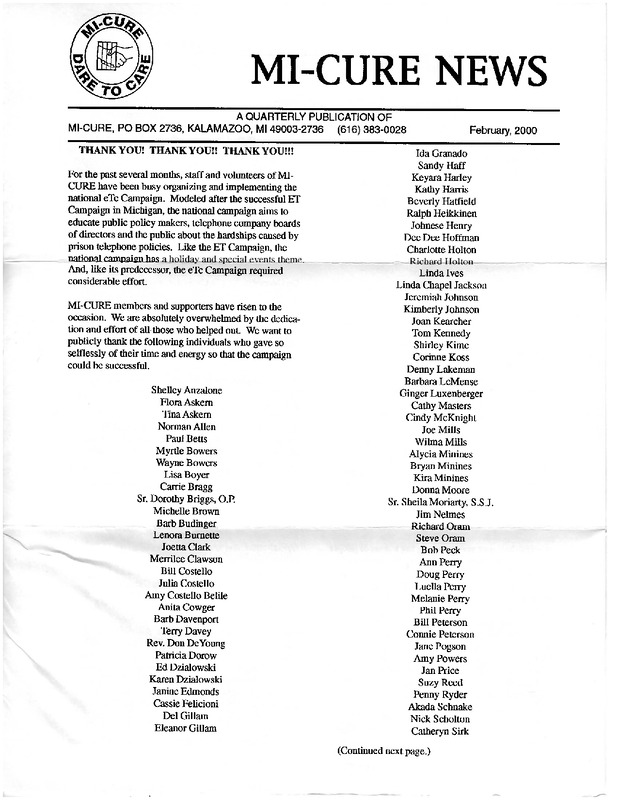
MI-CURE News (February 2000) covering excessive prison phone charges; Michigan laws stripping incarcerated individuals of civil rights protections and the ACLU lawsuit challenging them; concerns over MDOC restrictions on rehabilitative services; Illinois' death penalty moratorium and wrongful convictions; critiques of mandatory minimums, mass incarceration, and limits on parole appeals; and the impact of punitive school discipline policies on violence.
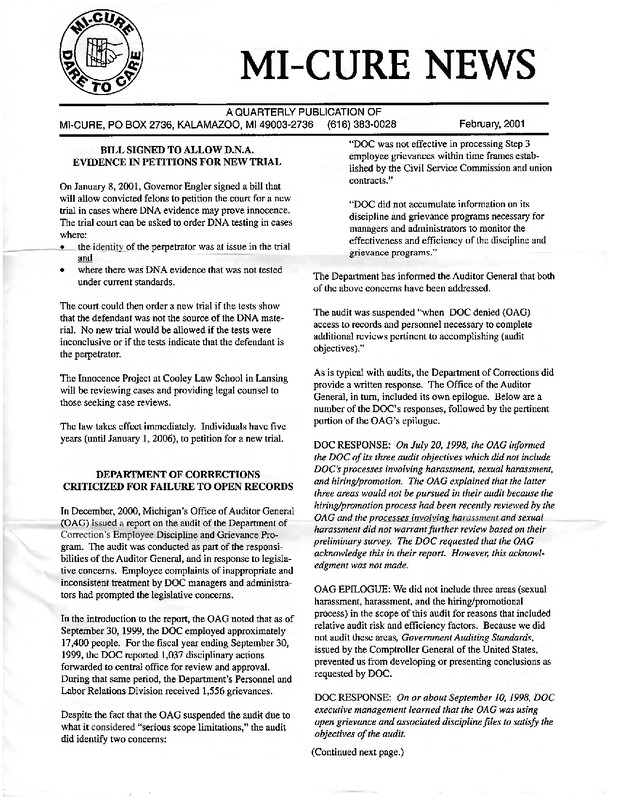
MI-CURE News (February 2001) covering Michigan’s new law on post-conviction DNA testing; MDOC’s obstruction of an investigation into employee discipline and grievances; updates on prison phone rate reform; MDOC limiting prisoner access to books; renewal of a $250 million no-bid healthcare contract despite concerns over inadequate care; national parole trends, including high reincarceration rates for minor violations; and California’s Prop 36, mandating drug treatment over incarceration for first-time offenders.
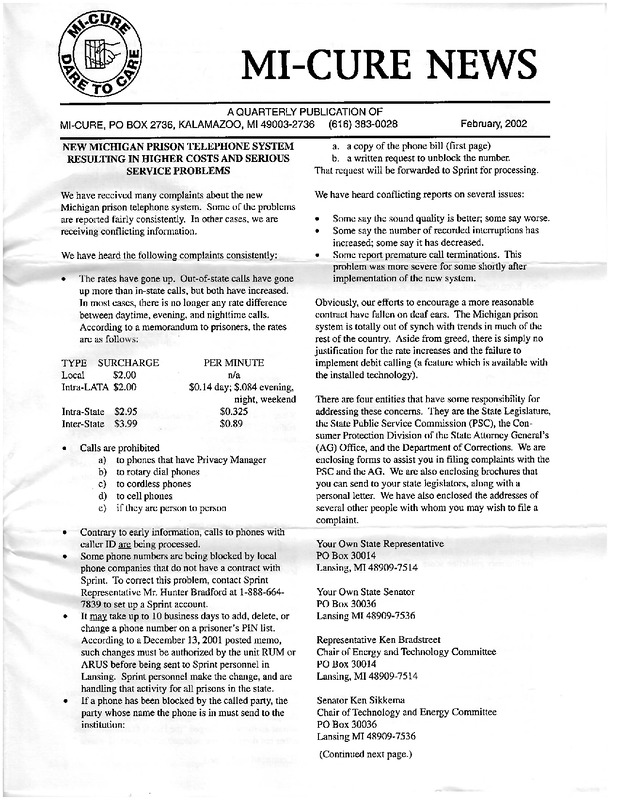
MI-CURE News (February 2002) covering worsening Michigan prison telephone issues; Parole Board guideline changes reducing high-probability parole cases; policy shifts banning money orders for prisoners; Governor Engler’s commutation of four sentences in 2001; DNA sample collection mandates for all prisoners; recent court rulings affecting prisoner rights; budget cuts impacting the MDOC; and the resignation of MDOC Director Bill Martin.
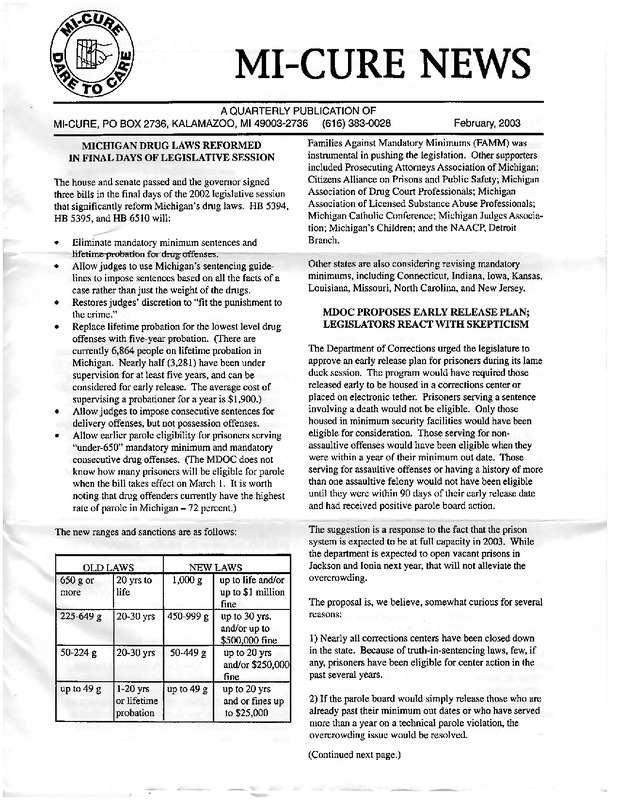
MI-CURE News (February 2003) covering major drug law reforms eliminating mandatory minimums and lifetime probation; MDOC’s early release proposal to address prison overcrowding; Supreme Court cases on prisoner visitation and voting rights; medical advocacy issues, including hepatitis C lawsuits; court rulings on parole, religious freedom, and legal rights; and prison conditions such as second-hand smoke exposure and Internet restrictions.
MI-CURE News (February 2004) covering flawed Michigan parole policies and recommendations for parole reform; MDOC’s Prisoner Reentry Initiative; new mentoring program for children of incarcerated parents; Oakland County’s mental health diversion program; legal rulings on parole denials and legal mail; UN Standard Minimum Rules for the Treatment of Prisoners; and expungement and child support kits in law libraries.