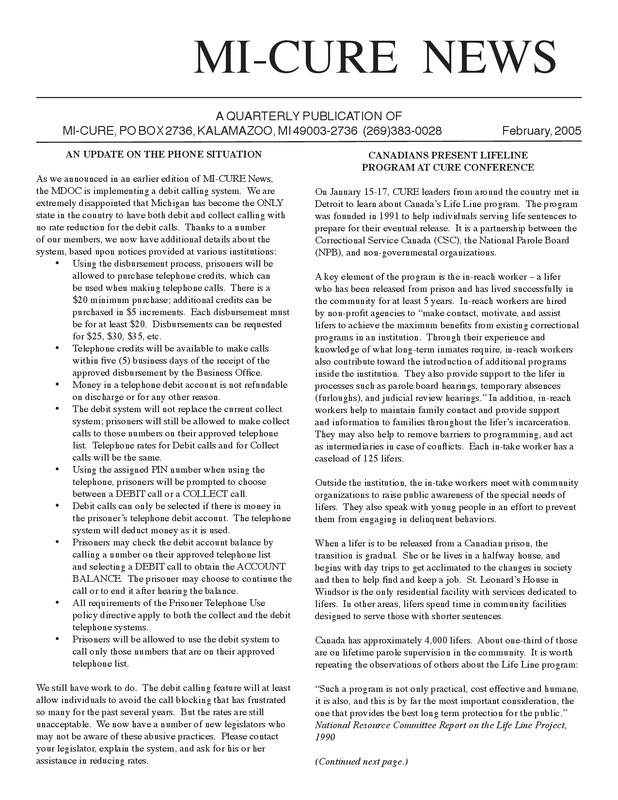
MI-CURE News (February 2005) covering Michigan’s implementation of a debit calling system for prisoners; a presentation on Canada's Life Line program; an expert’s view of MDOC’s health care system and advocacy for reform; recommended reading for parole planning; and continued discussion of the United Nations’ Standard Minimum Rules for the Treatment of Prisoners.
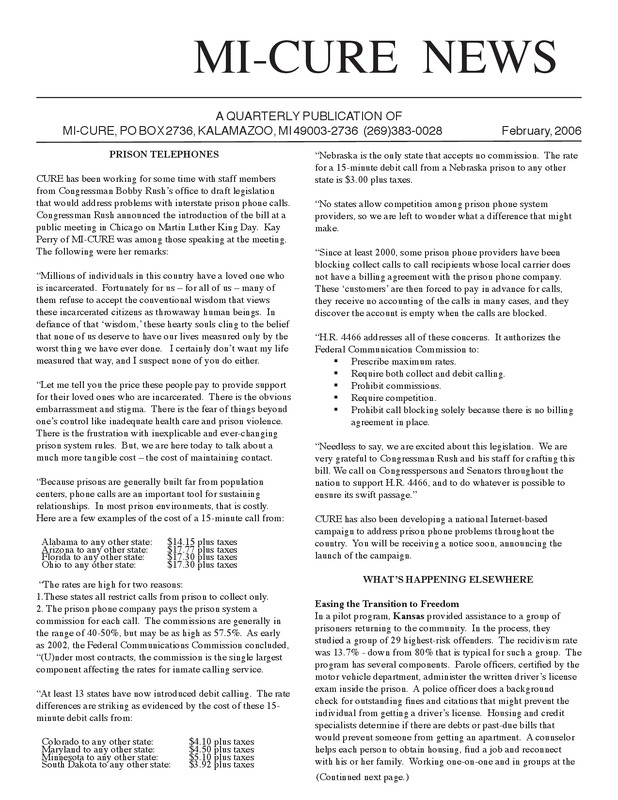
MI-CURE News (February 2006) covering legislation to address prison phone issues; updates on Kansas' reentry program for high-risk offenders; reporting on prison health care reforms; developments in Michigan legislation on good time credits, wrongful incarceration compensation, private prison prohibition, and sex offender laws; and updates on court rulings and litigation, including the ACLU's class action suit regarding appellate counsel.
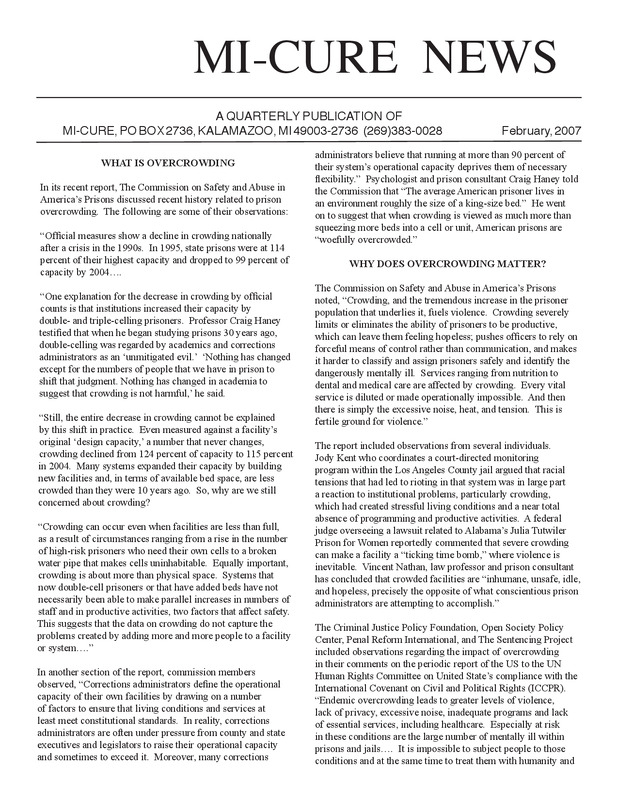
MI-CURE News (February 2007) covering the impact of overcrowding on safety, health, and productivity; proposals to reduce the prison population through parole, the release of elderly prisoners, and increased use of therapeutic justice programming; and ongoing issues with medical and mental health care in Michigan prisons.
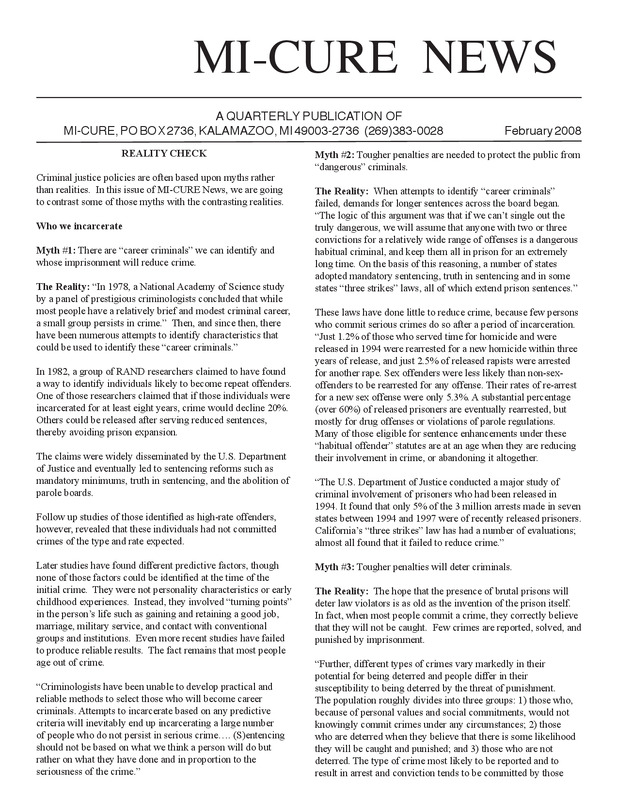
MI-CURE News (February 2008) covering a discussion of common myths about incarceration and their realities; and efforts to improve health care for incarcerated individuals; the Michigan Partners in Crisis campaign advocating for better mental health treatment for incarcerated individuals.
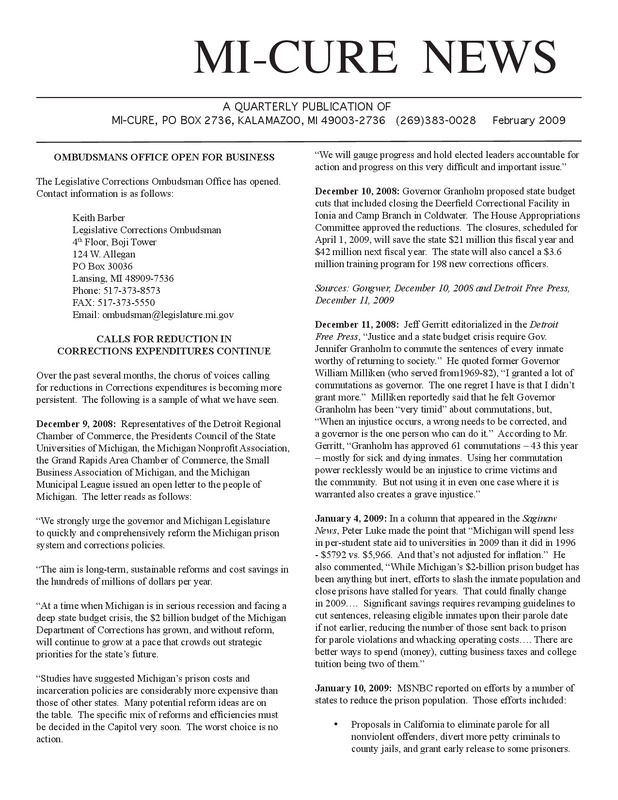
MI-CURE NEWS (February 2009) covering the opening of the Legislative Corrections Ombudsman Office; ongoing calls for corrections budget cuts; Governor Granholm’s commutation power and proposals for reducing prison populations; CAPPS recommendations for sentencing reform and improved parole policies; MDOC health care provider change; MI-CURE’s focus on improving health care services and oversight; and challenges related to overcrowding and prison reform.
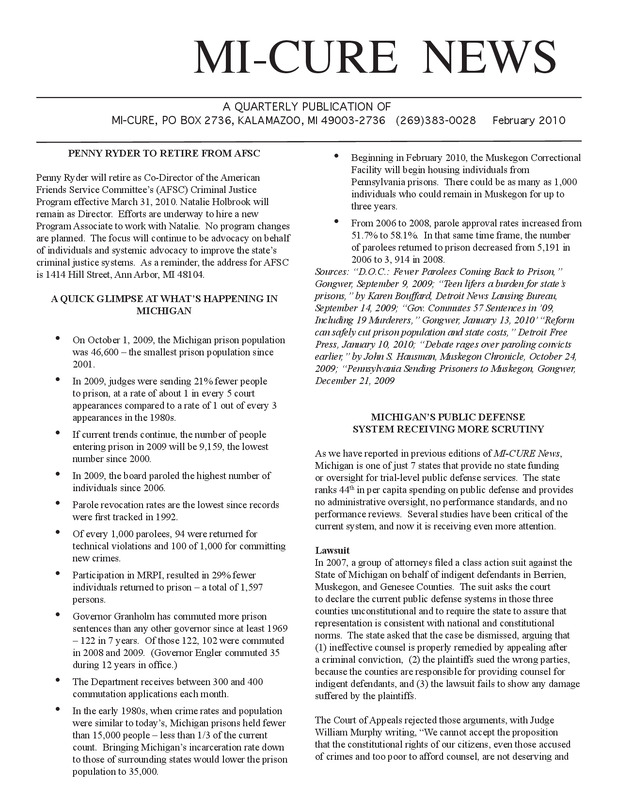
MI-CURE NEWS (February 2010) covering a decrease in Michigan’s prison population and higher parole approval rates; the Duncan v. State of Michigan lawsuit challenging the public defense system; media concerns over low public defense funding; legislative proposals for a statewide defense system; the national decline in death sentences; voting rights for incarcerated individuals; the effects of solitary confinement; problem-solving courts for addiction; and the harmful impacts of incarceration.
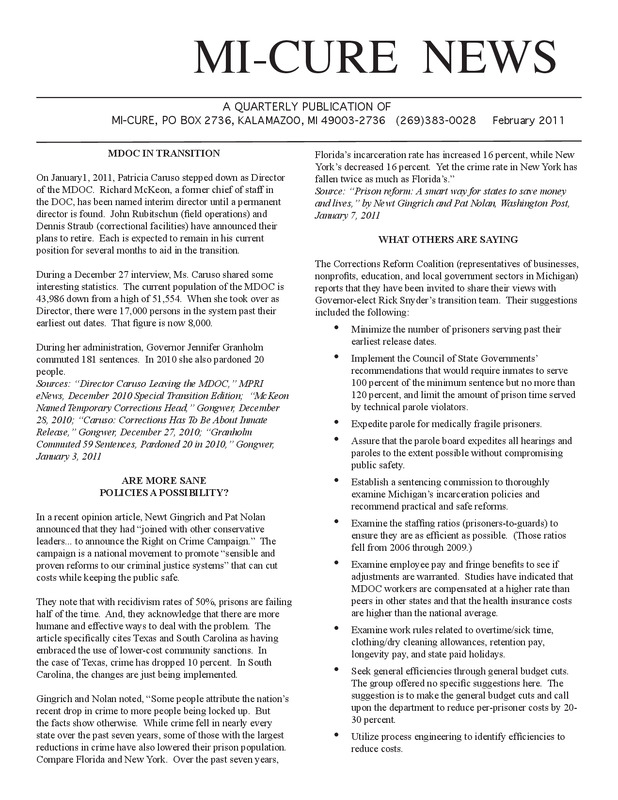
MI-CURE NEWS (February 2011) covering the director change in MDOC; reforms in Michigan's incarceration practices; proposals for re-entry programs; discussions about criminal justice reform including recidivism rates, prison population trends, and the Right on Crime campaign; updates on recent legislative changes, including bills on parole procedures, prisoner medical records, and vocational training programs; human rights critiques in correctional facilities; prosecutorial misconduct; continuing education for prisoners post-release; and addressing sexual abuse in jails.
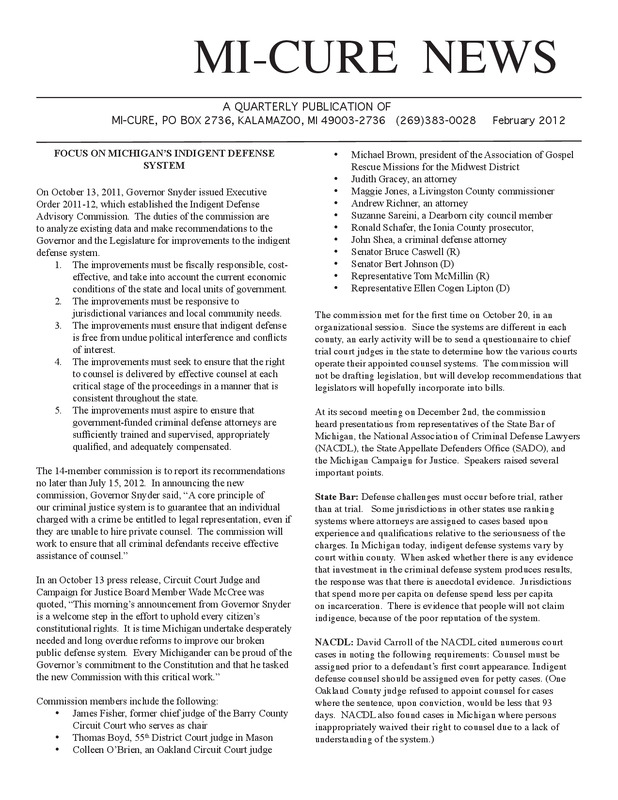
MI-CURE NEWS (February 2012) covering the establishment of Michigan’s Indigent Defense Advisory Commission; a report on the use of GPS tracking for released offenders; the overturning of a parole denial and a Circuit Court decision for resentencing a juvenile offender under recent U.S. Supreme Court rulings; a discussion on the challenges of incarcerating individuals with mental illnesses; and support for compassionate release and better management of chronic pain for incarcerated individuals.
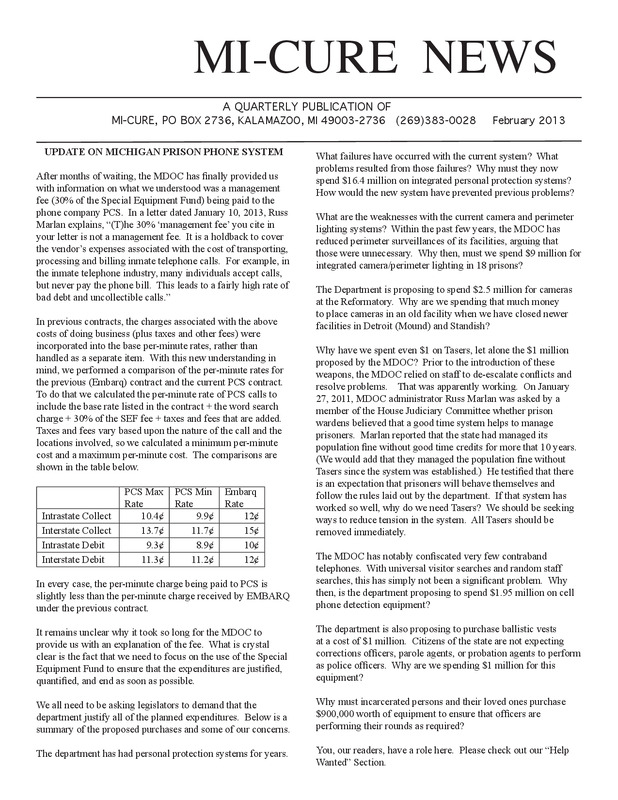
MI-CURE NEWS (February 2013) covering MDOC’s prison phone system and SEF concerns; visitation's positive impact on recidivism; Kay Perry’s legislative address on phone rates, healthcare, overcrowding, and wages; MDOC’s backlog in therapy programs; concerns over 12-hour shifts at Newberry; and updates on forensic evidence review and sex offender registry removal petitions
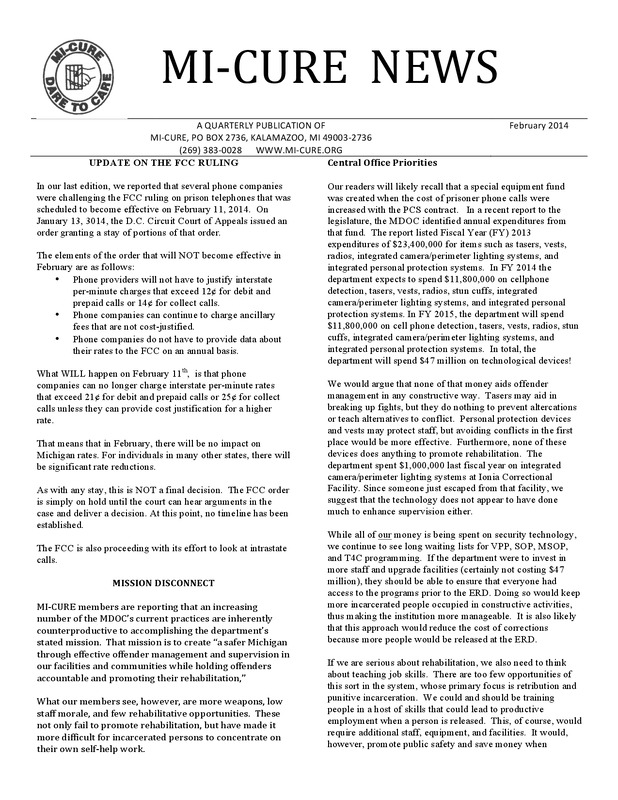
MI-CURE News (February 2014) covering updates on the FCC ruling on prison phone rates; concerns over MDOC’s spending priorities and lack of rehabilitative programming; the backlog in Violence Prevention and Sex Offender Programming; developments in Michigan’s juvenile life without parole cases; updates on litigation related to indigent defense, lifetime electronic monitoring, and religious accommodations in prison; and new legislation expanding mental health courts.
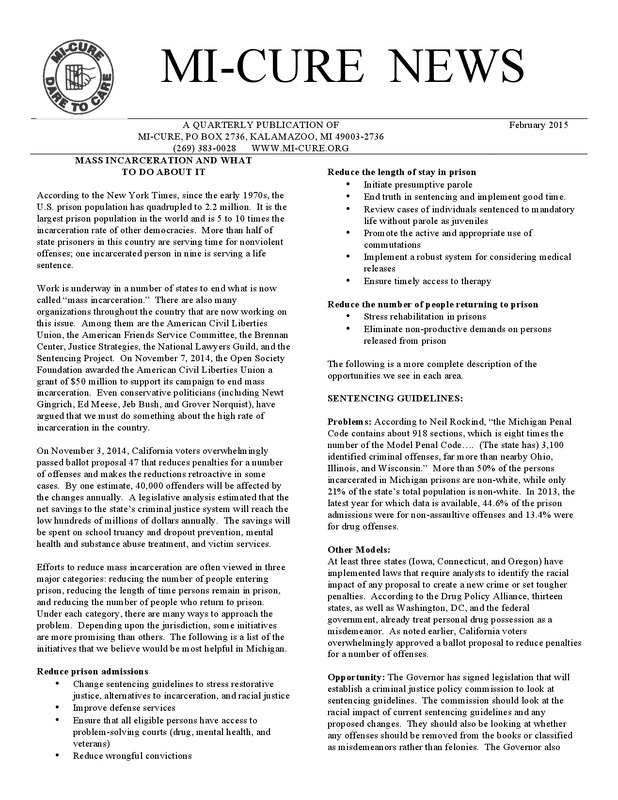
MI-CURE News (February 2015) covering proposals for reducing prison admissions, sentence lengths, and recidivism; critiques of Michigan’s sentencing guidelines, parole system, and lack of access to education and rehabilitation programs; support for presumptive parole, reinstatement of good time, and juvenile life sentence reform; calls to expand problem-solving courts and wrongful conviction safeguards; updates on medical release, commutation practices, and barriers to reentry; legislative changes on expungement, Medicaid, and criminal justice oversight; developments in FCC regulation of prison phone rates; and national initiatives on mental health, prison education audits, and criminal case mediation alternatives.
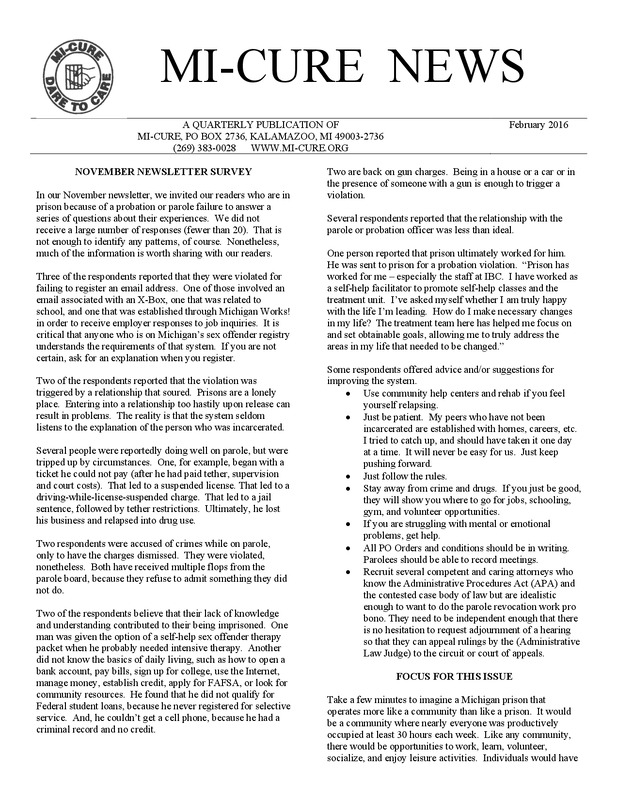
MI-CURE News (February 2016) covering survey responses from incarcerated individuals on probation and parole violations; updates on the Michigan Collaborative to End Mass Incarceration’s policy goals and coalition-building; FCC progress on reducing prison phone call rates; SCOTUS Montgomery v. Louisiana decision applying juvenile LWOP ban retroactively; clemency trends and critique of Michigan’s limited use; legal victory striking down broad employment bans for people with records; national efforts challenging cash bail systems and fines; and legislative momentum in Michigan to raise the age of juvenile court jurisdiction and protect youth in custody.
MI-CURE News (February 2017) covering survey findings on improving Michigan’s prison grievance systemy; legislative reforms expanding compensation for wrongful convictions and limiting judge interference with parole decisions; critiques of electronic monitoring as a carceral extension; concerns over user fees and their burden on poor defendants; research linking traumatic brain injury to incarceration risk; ACLU’s report on the harm of solitary confinement for people with physical disabilities; updates on job-readiness programs for returning citizens; and new developments in electronic court filing access and voting rights for incarcerated individuals.
MI-CURE News (February 2018) covering an investigation into Taser misuse and deaths in custody; calls to downsize and reform probation and parole systems; efforts to ensure the right to legal counsel at arraignment in Michigan; racial disparities in plea bargaining and national defense system strains; expanding access to expungement and second chances for formerly incarcerated individuals; the role of neuroscience in corrections policy and treatment programming; urgent concerns over delayed mental health evaluations and treatment; and forward-thinking reforms in prison education, community investment, compassionate release, and juvenile justice.
MI-CURE News (February 2019) covering the ACLU’s Smart Justice campaign for bail and sentencing reform; mentorship and enrichment programs and a new Vocational Village for women; prosecutorial reform; national efforts to improve probation and parole systems; critiques and innovations in bail reform, including Detroit’s Bail Project; clemency trends among governors and presidents; growing support for holistic defense models; debate over conscientious acquittals and jury nullification; and continued exposure of flawed forensic science.
MI-CURE News (February 2020) covering low wages, court fees, and debt as barriers to reentry; calls to end court-imposed fees and assess fines by ability to pay; innovative prison programs—peer-led rehab, tech training, book clubs, parole prep, and prison newspapers; expanded reentry support—housing stipends, ban-the-box hiring, and job fairs; reforms restoring jury and voting rights; mental health diversion and crisis response models; push to expand expungement and end Medicaid bans for pretrial detainees; and new laws on mental health discharge planning and college aid for incarcerated people.
MI-CURE News (February 2021) covering calls to revive prison newspapers; challenges in prison education and Pell Grant restoration; lack of support for incarcerated people with disabilities; probation and parole reform; broken prison grievance systems; support strategies for children of incarcerated parents; backlog in competency evaluations; major legislative wins on expungement, licensing, and SORA; trial penalty clemency efforts; prison food quality issues; restorative justice dialogue programs; wrongful conviction reviews; and recidivism-reduction program standards.
MI-CURE News (February 2022) covering Michigan’s campaign for free prison calls; FCC rate caps and GTL settlement; attorney-client call recording lawsuits; legal challenges to sex offender registry laws; push for independent prison oversight; prosecutorial reforms and conviction reviews; calls for judicial accountability and sentencing reform; efforts to reduce racial bias in jury selection; correctional health care from jail physicians; solitary confinement advocacy; juvenile LWOP reform bills; wrongful conviction reviews; and media reform in crime reporting.
MI-CURE News (February 2023) covering federal prison phone and camera reform laws; innovative prison programs in tech, trades, and ecology; sex offender registry litigation updates; bail reform; expanded opioid treatment access; improved standards and pay for Michigan public defenders; increased pardons and commutations; mental health care reforms in MA prisons; defense advocacy and wrongful conviction concerns; and a Maine prison debate team victory over MIT.
MI-CURE News (February 2024) covering innovative in-prison programming including employment for degreed individuals and Norwegian-style housing units; updates on free tablet and phone programs in jails; litigation progress in Michigan’s sex offender registry case; expansion of mobile mental health and urgent care services across Michigan; push for holistic defense practices and court reform; reentry supports like stimulus payments, housing stipends, and broadband training; solitary confinement bans and culture shift efforts; growing concerns over AI and facial recognition in policing; new research linking ACEs to violent offending; legislation on tuition access, juvenile justice, and transparency; and progress on expungement, voter registration, and indigent defense reforms.
MI-CURE News (July-August 2002) covering gubernatorial candidate responses on prison policies, family contact, mental health, and privatization; worsening prison telephone conditions; a federal court ruling declaring Michigan’s public sex offender registry unconstitutional; and updates on expungement eligibility and procedures.
MI-CURE News (May 1991) covering efforts to improve prison visitation policies; advocacy for bathroom access; concerns over the new Corrections Director; a prison self-help group for sex offenders; phone restrictions in administrative segregation; and opposition to Level 6 prisons.
MI-CURE News (May 1992) covering opposition to MDOC’s rule changes; premature policy enforcement concerns; efforts against federal control units; links between education and incarceration; and legislative efforts to improve correctional education and reduce recidivism.
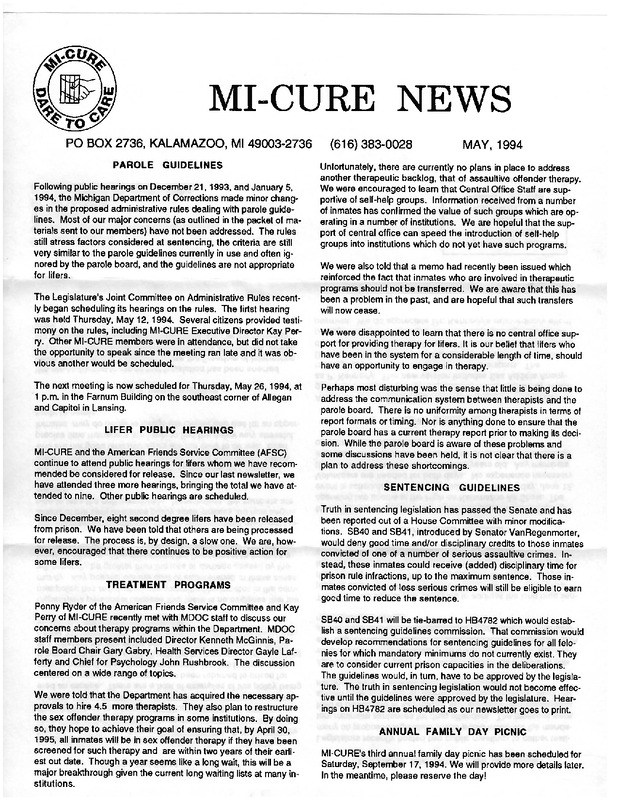
MI-CURE News (May 1994) covering parole guidelines; lifer public hearings; therapy program shortages; Truth in Sentencing; Zero Tolerance Policy for Corrections Centers and tether programs; FOIA restrictions on inmates; mandatory minimum sentence hearings; and publication of a sex offender treatment directory.