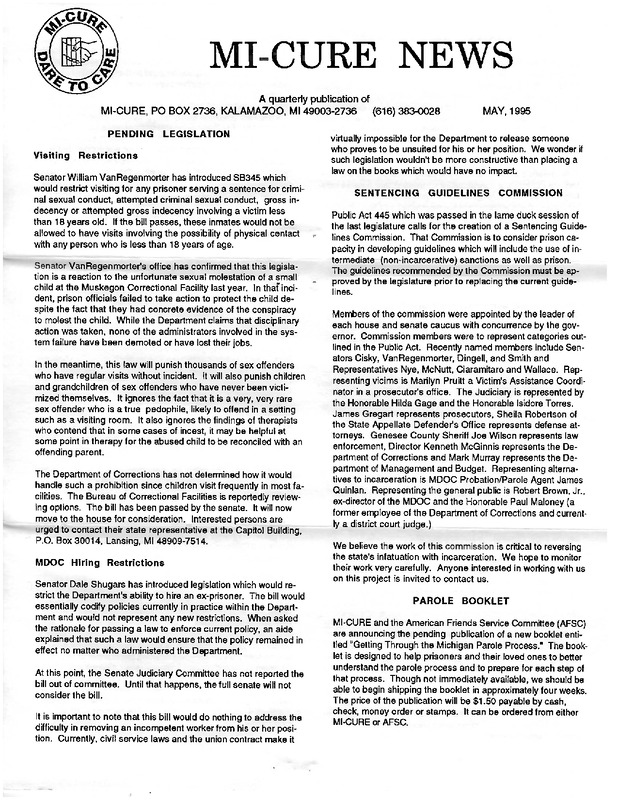
MI-CURE News (May 1995) covering proposed visitation restrictions for sex offenders (SB345); efforts to codify MDOC hiring restrictions for ex-prisoners; the establishment of a Sentencing Guidelines Commission; concerns over the Zero Tolerance Policy’s impact on community placements; a legal ruling on permanent visitor restrictions (Kelley v. MDOC); and fraudulent phone charges affecting prisoners’ families.
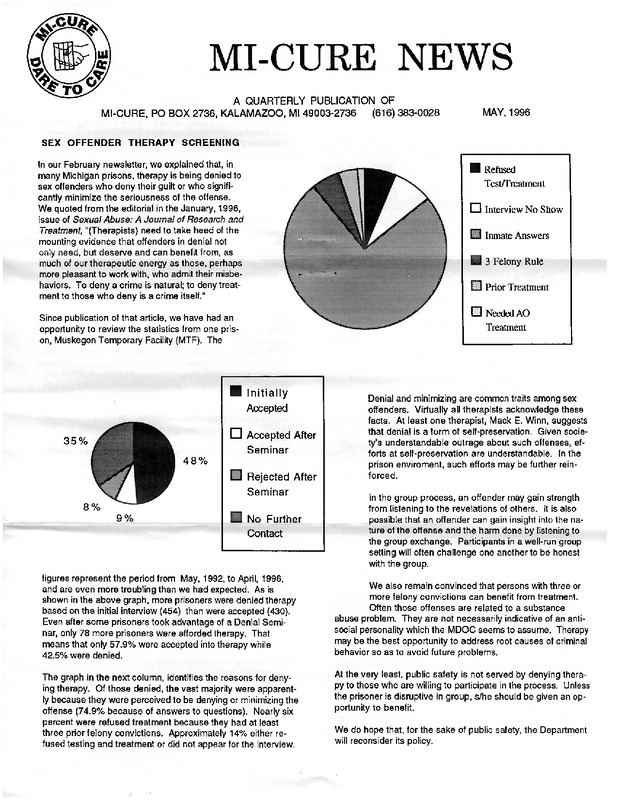
MI-CURE News (May 1996) covering barriers to sex offender therapy in Michigan prisons; concerns over officer misconduct; proposed changes to the Sex Offender Registration Act; and rising telephone costs for incarcerated individuals after deregulation.
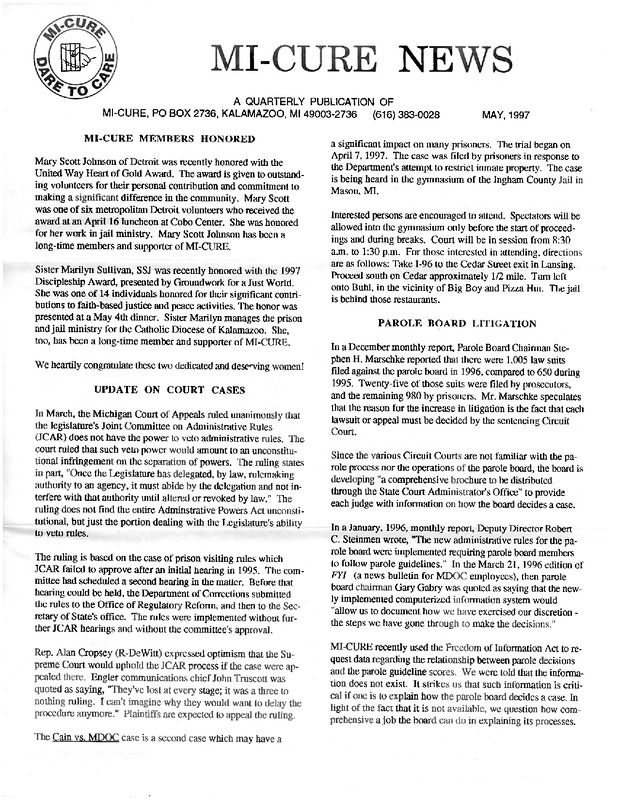
MI-CURE News (May 1997) covering court rulings on legislative veto power and inmate property restrictions; ongoing parole board litigation and transparency concerns; disparities in parole board access for victims and prisoners' families; legislative updates on felony murder appeals, sentencing reforms, and parole restrictions; and concerns over Michigan’s prison phone system and Virginia’s study on inmate call charges.
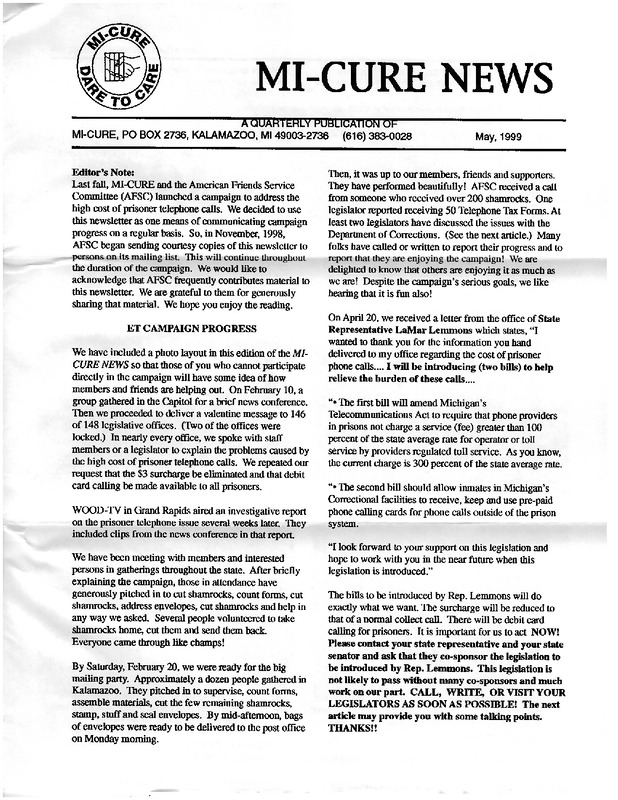
MI-CURE News (May 1999) covering the campaign against excessive prisoner phone surcharges; parole restrictions prohibiting sex offenders from contacting their children; closure of Michigan correction centers due to truth-in-sentencing; impact of cognitive restructuring programs on parolees; legislative updates on sex offender laws, the death penalty, and prisoner litigation restrictions; and termination of a privatized healthcare contract.
MI-CURE News (May 2000) covering efforts to reduce prisoner phone costs; concerns over privatized prison healthcare; Michigan’s rising prison population and economic burdens on families; critiques of restrictive media access and systemic barriers to rehabilitation; a federal court ruling on habeas corpus petitions; and continued advocacy for humane corrections policies and legislative oversight.
MI-CURE News (May 2001) covering Michigan’s unnecessary prison expansion; the parole board’s conservative approach, declining parole approvals, and delays due to inadequate therapy programs; Hepatitis C crisis in prisons; proposed changes to prison education programs; concerns about control unit prisons and their psychological effects; and the expansion of women’s prison facilities in Michigan.
MI-CURE News (May 2002) covering a ruling striking down MDOC’s restrictive visitation policies; advocacy against excessive prison phone rates; concerns over MDOC policies limiting prisoner mail and money orders; court rulings on parole rights; a ballot initiative to replace mandatory drug sentences with treatment; and reports on jail deaths in Detroit due to medical neglect.
MI-CURE News (May 2003) covering MDOC’s five-year plan to manage prison growth and reduce costs; legislative updates on sentencing guidelines, parole, and drug treatment courts; healthcare policies including increased co-pays and use of generic medications; Hepatitis C lawsuits against MDOC for inadequate testing and treatment; advocacy updates on prison phone rates and lobbying efforts; court rulings on parole, sentencing, and prisoners' rights; and prison conditions including disease outbreaks and restrictive visitation policies.
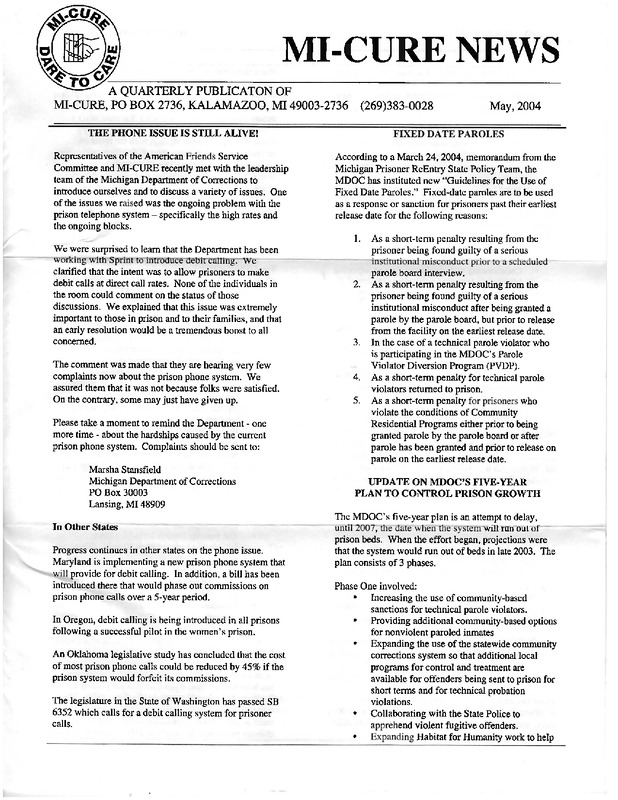
MI-CURE News (May 2004) covering prison phone system issues; fixed-date parole policies; MDOC’s plan to manage prison population; fraudulent parole services warning; new parole program for female offenders; second-hand smoke concerns; legislation on lifer parole reviews; federal sentencing reforms and judicial discretion; wrongful convictions study; international criticisms of U.S. criminal justice policies; UN Standard Minimum Rules for Prisoners; and SCOTUS case on indigent legal representation.
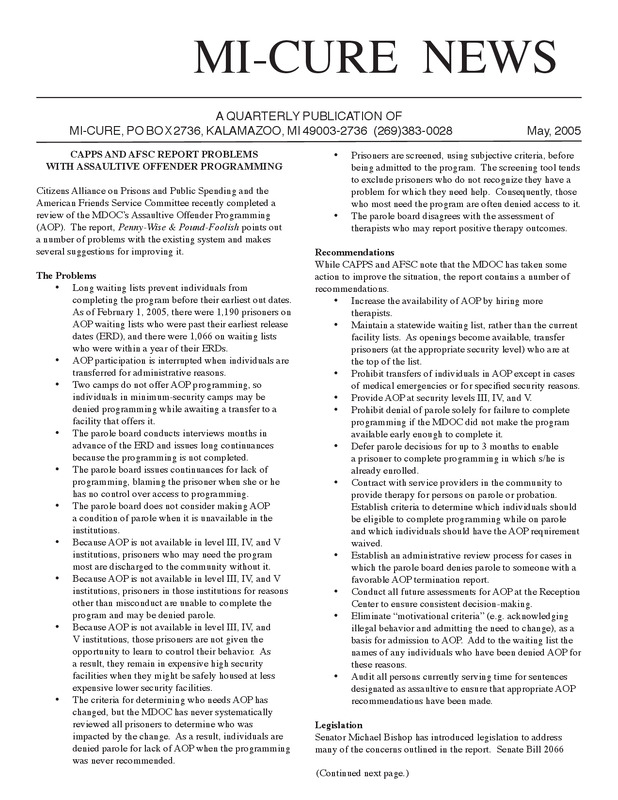
MI-CURE News (May 2005) covering issues and reccomendations regarding Michigan’s Assaultive Offender Programming; recent court rulings on prison policies, parole, and healthcare; challenges to Michigan’s incarceration rate and suggestions for reform; and a focus on the United Nations’ Standard Minimum Rules for the Treatment of Prisoners.
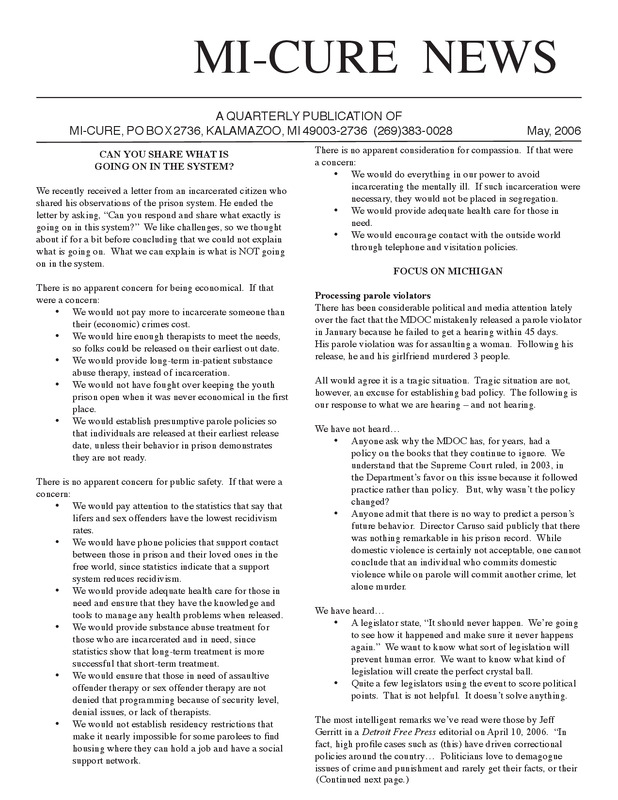
MI-CURE News (May 2006) covering concerns over inefficiencies and lack of compassion within the prison system; updates on Michigan's parole violator policy and proposed legislative changes; reporting on changes in the Parole Board’s policy to accept letters; developments in Michigan legislation on good time credits, wrongful incarceration compensation, and the Second Chance Act; and discussions on the impact of residency restrictions for sex offenders and the accessibility of criminal records.
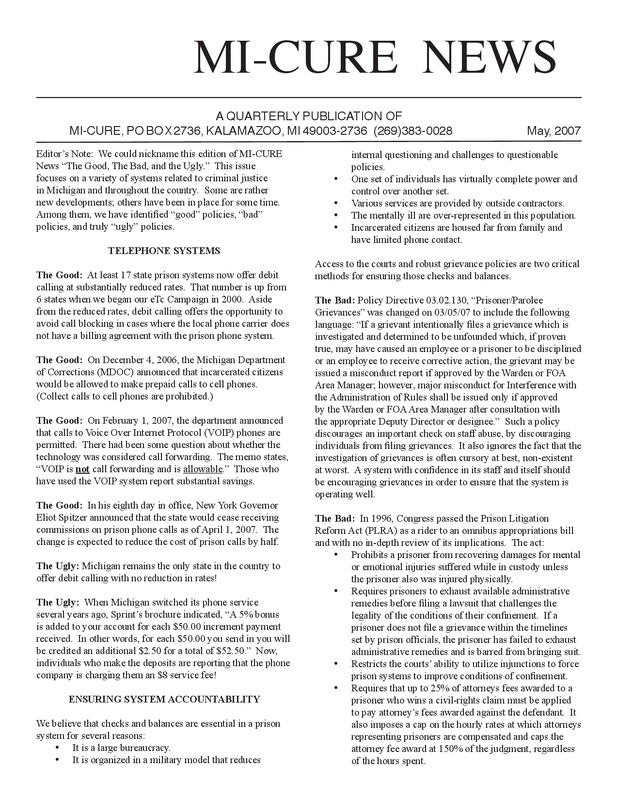
MI-CURE News (May 2007) covering a range of criminal justice topics with a focus on policies in Michigan and nationwide, categorized as “good,” “bad,” and “ugly”; highlights include reduced phone rates in prisons, the potential release of minor, nonviolent offenders, and a new re-entry lawaimed at improving post-incarceration outcomes; also covered are concerning issues like the exploitation of prison labor in Colorado, Michigan's inadequate prison health care system, and the financial hurdles facing former prisoners; the issue also touches on ongoing legislation affecting parole, prison phone systems, and juvenile sentencing.
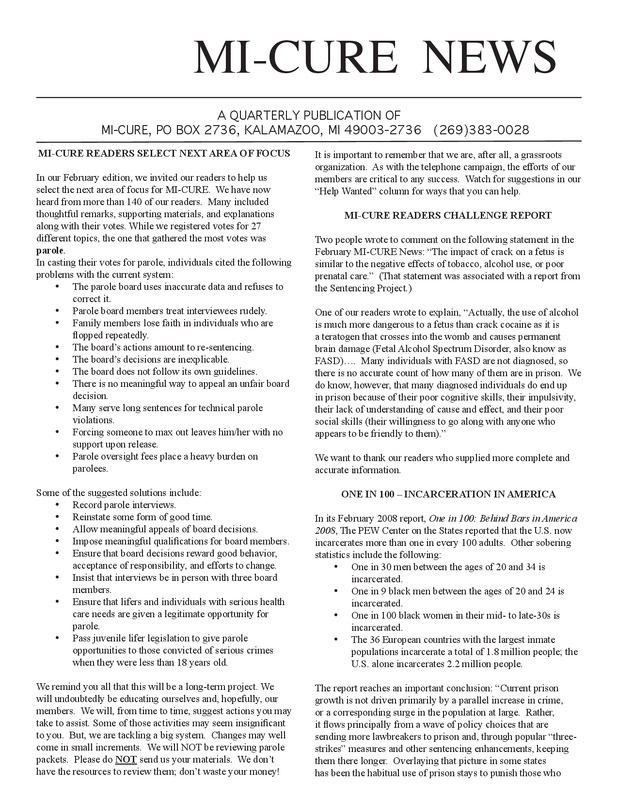
MI-CURE News (May 2008) covering a report on the U.S. incarceration rate, emphasizing the disproportionate number of black and young individuals in prison and discussing state efforts to reduce corrections costs through sentencing reforms, parole policies, and diversion programs; recommendations from the JFA Institute for reducing prison populations, such as eliminating prison for technical parole violations and reducing time served; and updates on Michigan’s parole system, including a federal court ruling on parole practices for lifers and ongoing efforts to address healthcare in Michigan’s prisons.
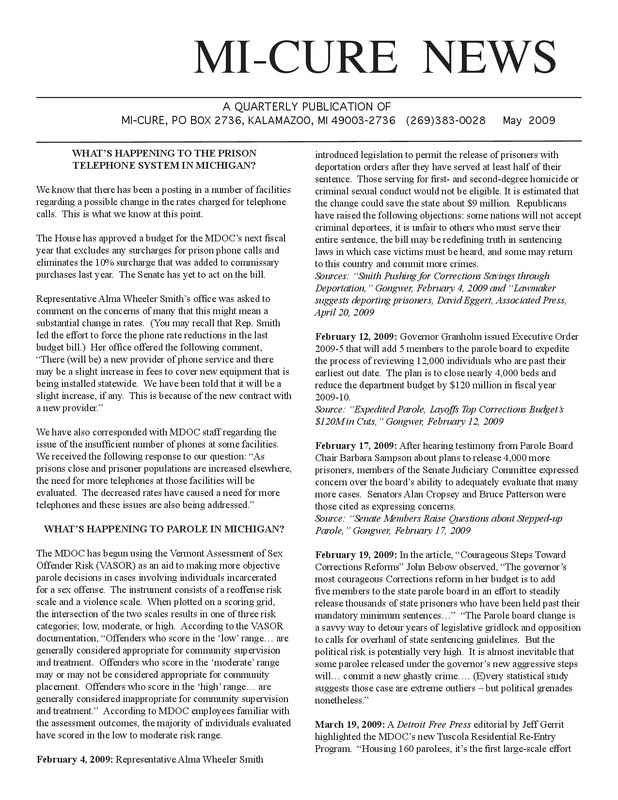
MI-CURE NEWS (May 2009) covering updates on Michigan's prison telephone system; the use of the Vermont Assessment of Sex Offender Risk (VASOR) for more objective parole decisions; proposal to release prisoners with deportation orders early; the MDOC's new Residential Re-Entry Program for high-risk parolees; updates on sentencing and parole policies, including the debate over funding mental health courts; facility conversions and employee layoffs; and new criminal justice reforms in other states.
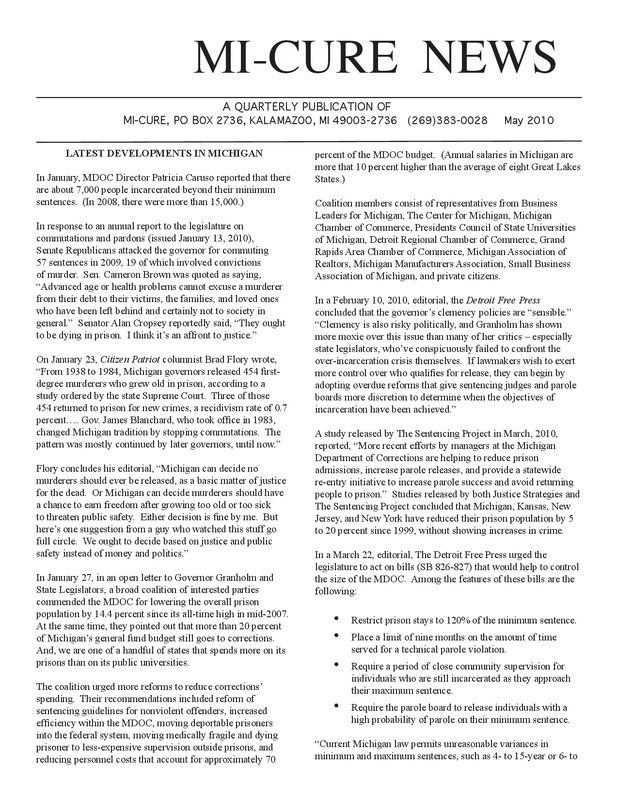
MI-CURE NEWS (May 2010) covering MDOC's ongoing efforts to reduce its incarcerated population and the controversy surrounding the commutation of sentences; the debate over the restoration of good time credits and the related political pushback; gaps in healthcare and recommendations for improvement; ongoing discussions about the representation of incarcerated individuals in the census and its impact on legislative districts; a lawsuit regarding inadequate medical care in county jails; and the challenges faced by deaf prisoners.
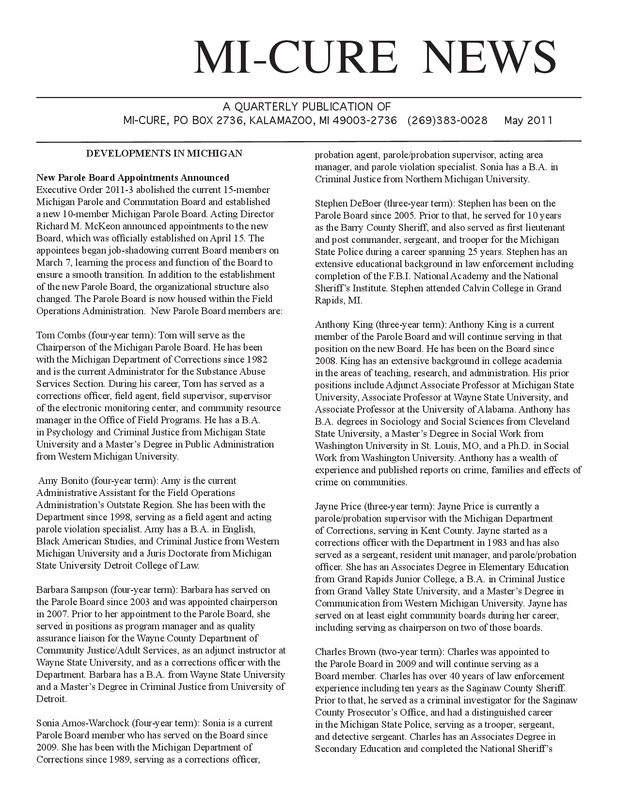
MI-CURE NEWS (May 2011) covering Executive Order 2011-3 abolisheing 15-member parole board; facilitity closure due to prison population decline; MDOC negotiating new phone service contract with Public Communication Services (PCS); Michigan’s sex offender registry to be reformed, including removal of “Romeo and Juliet” offenders; food service privatization under consideration; MDOC’s Prisoner Reentry Initiative criticized for poor contract monitoring; AFSC seeking feedback on Michigan’s grievance process; recent mergers in correctional healthcare companies; proposal for computers in prison cells to aid rehabilitation; and criticisms of privatization, especially in food services and healthcare.
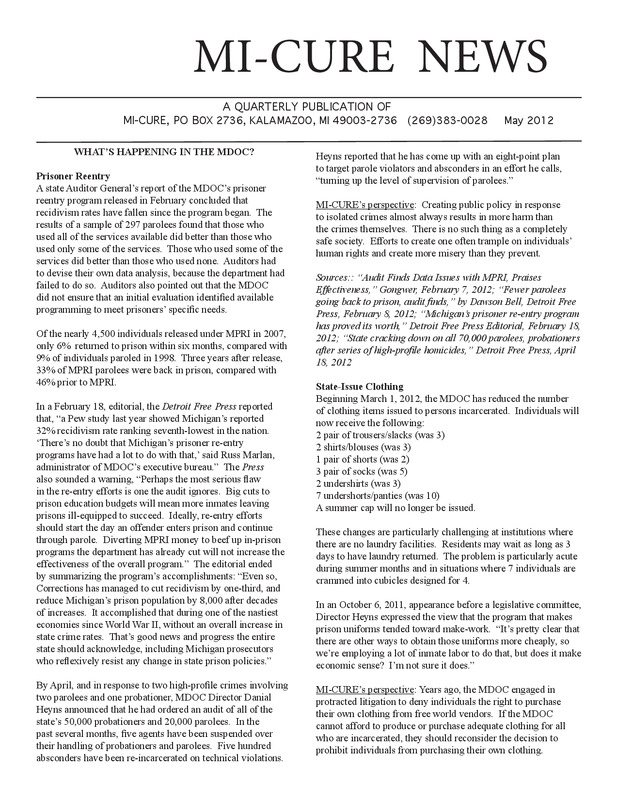
MI-CURE NEWS (May 2012) covering the effectiveness of the MDOC’s prisoner reentry program; the end of sexually abusive searches at the Huron Valley Correctional Facility following ACLU intervention; the introduction of Tasers in five state prisons as a pilot program to prevent inmate violence; a new sales tax on prison commissary purchases; updates on cost-cutting initiatives within the MDOC; ongoing challenges with access to programming; and the push for privatization of prisons.
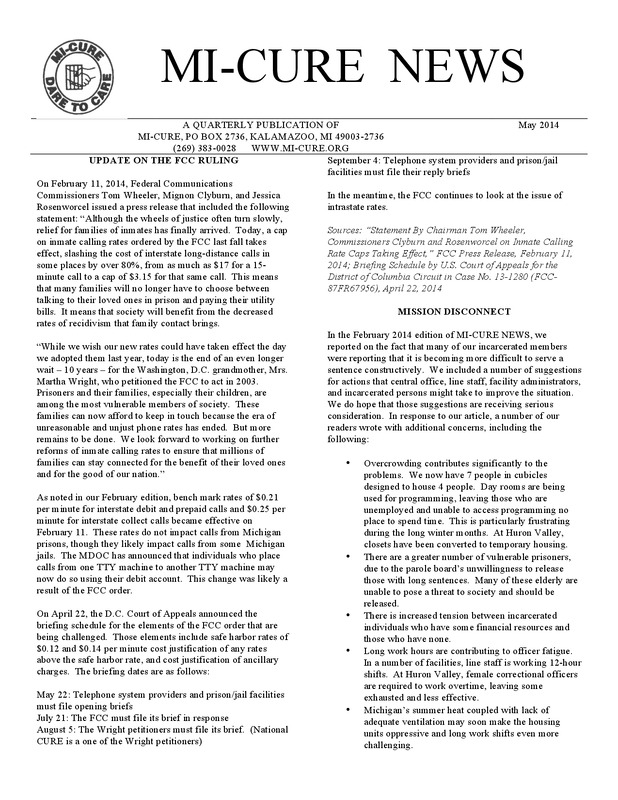
MI-CURE News (May 2014) covering updates on the FCC ruling on prison phone rates; concerns over MDOC overcrowding, staffing issues, and rehabilitation program access; programming backlog statistics for VPP, SOP, and T4C; challenges in prison education and vocational training; developments in food service privatization with Aramark; national efforts to reform solitary confinement policies; a partnership between MSU and MDOC on prison healthcare models; Medicaid expansion for parolees; discussions on clemency reform at state and federal levels; and advocacy suggestions for legislative and MDOC policy changes.
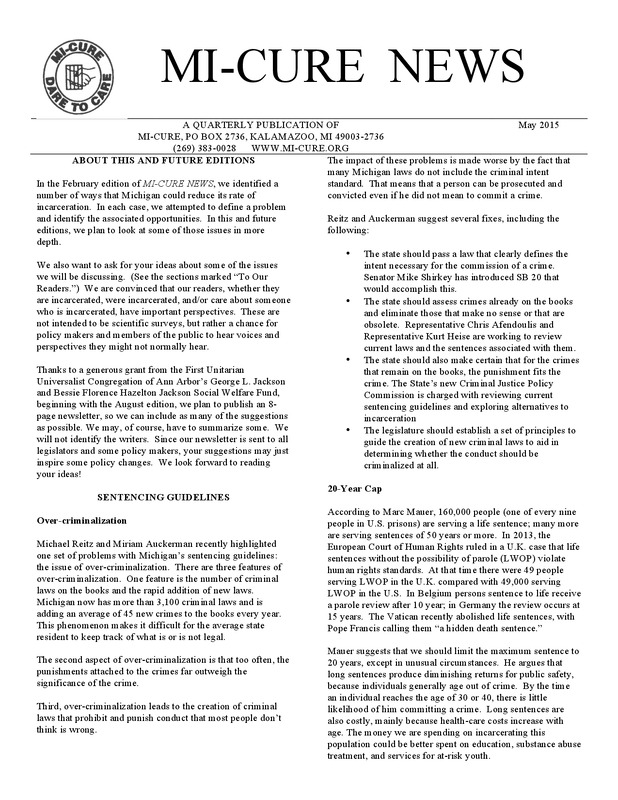
MI-CURE News (May 2015) covering deeper analysis of Michigan’s sentencing policies; critiques of over-criminalization and calls for intent standards in criminal law; support for raising the juvenile court age to 18 and addressing racial disparities in sentencing; discussion on establishing a living wage for incarcerated individuals; forensic evidence reliability issues and FBI testimony flaws; updates on prison phone rate reforms, litigation on behalf of deaf prisoners, and Wayne County’s rape kit backlog; new restrictions for those labeled as gang-affiliated; and critique of MDOC’s punitive practices vs. evidence-based rehabilitation.
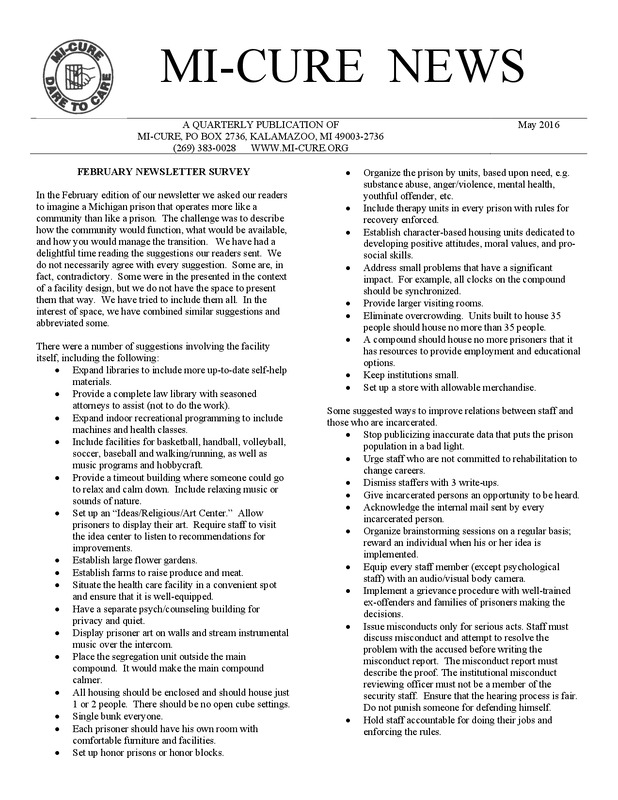
MI-CURE News (May 2016) covering examples of humane corrections practices in Idaho and German prisons; MDOC’s launch of Vocational Village for job-readiness training; concerns over unfit correctional staff and systemic oversight failures in New Yor; court-ordered reforms to end debtor’s prison practices in Michigan; launch of MDOC hospice and palliative care pilot program; push for post-conviction innocence evidence disclosure; and federal ruling against prison gerrymandering.
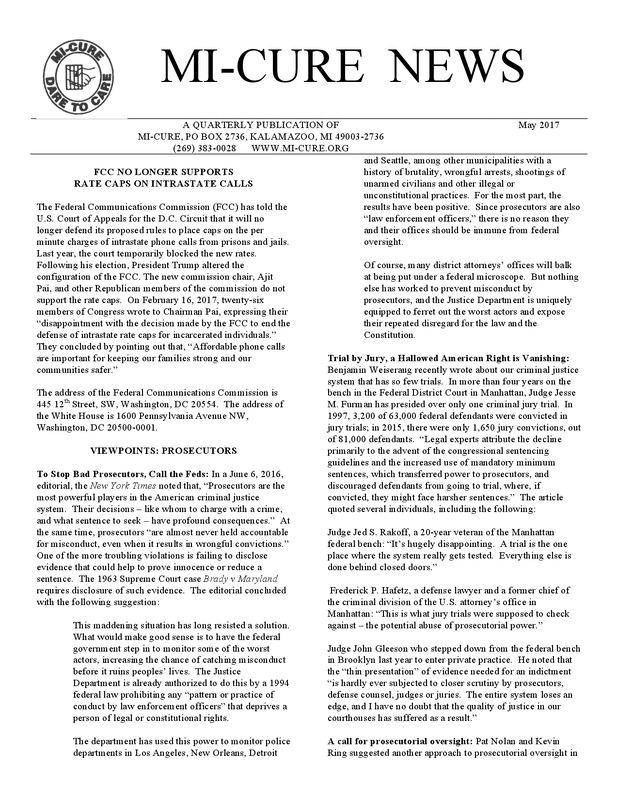
MI-CURE News (May 2017) covering FCC withdrawal from prison phone rate caps; calls for prosecutorial oversight and concerns over declining jury trials; solitary confinement reforms driven by staff and DOJ mandates; critiques of prison food, healthcare copays, and loss of in-person visits; arguments for restoring prisoner voting rights; proposals to reduce recidivism through healthcare-inspired reforms; mental health diversion strategies; indigent defense innovations including client choice and social worker integration; and expanded prison education and rehabilitation programs.
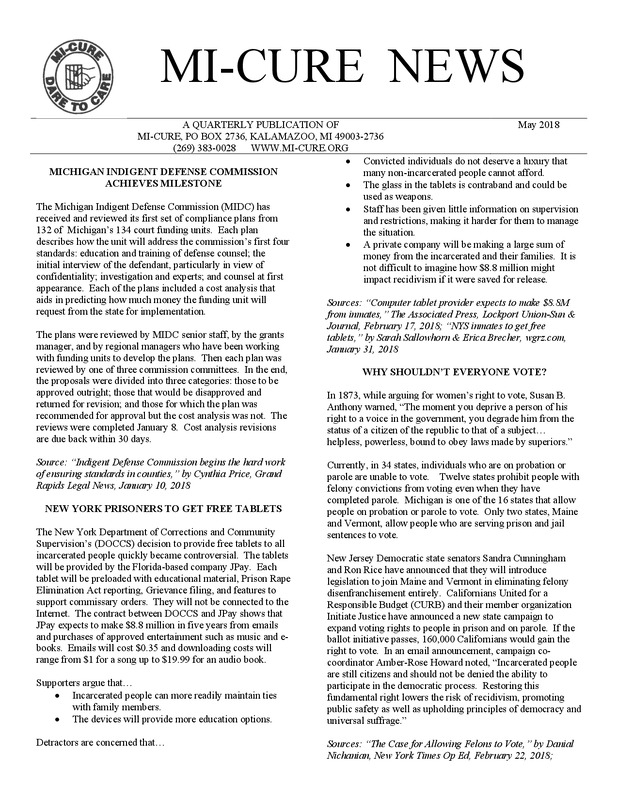
MI-CURE News (May 2018) covering Michigan’s progress on indigent defense reform; national efforts to restore voting rights and expand prison education; scrutiny of prosecutors and conviction integrity units; underused compassionate release for elderly and ill prisoners; links between healthcare and incarceration; prison system failures in addressing the opioid crisis; key court rulings for juvenile lifers and prisoner rights; and local and national pushes for more humane, evidence-based justice policies.
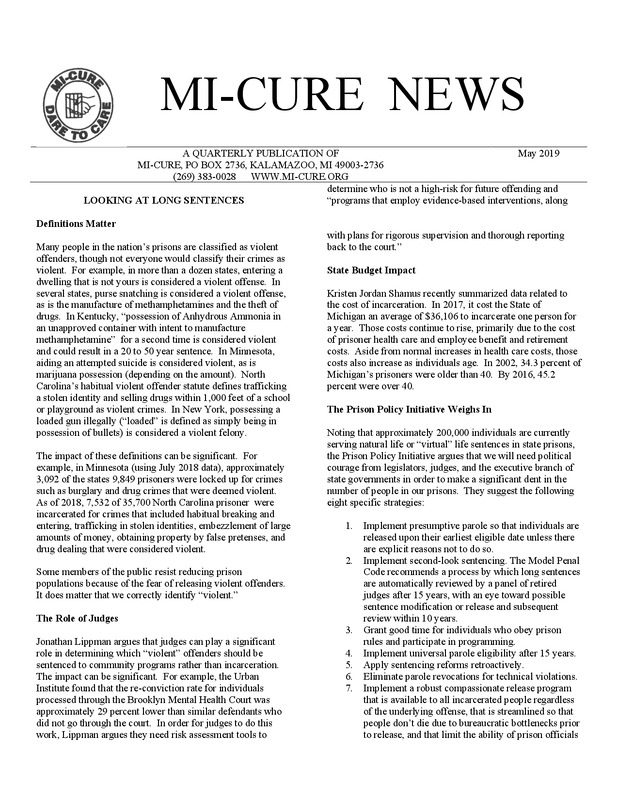
MI-CURE News (May 2019) covering the overbroad classification of violent offenses and calls to reduce extreme sentences; proposed reforms including second-look sentencing, presumptive parole, and expanded expungement access; Michigan jail population review and sex offender registry litigation; prison phone call affordability and telecom accountability; implementation of early counsel access improving pretrial justice; critiques of prison food, commissary costs, and subminimum wages; and stories of leadership, writing, and redemption.
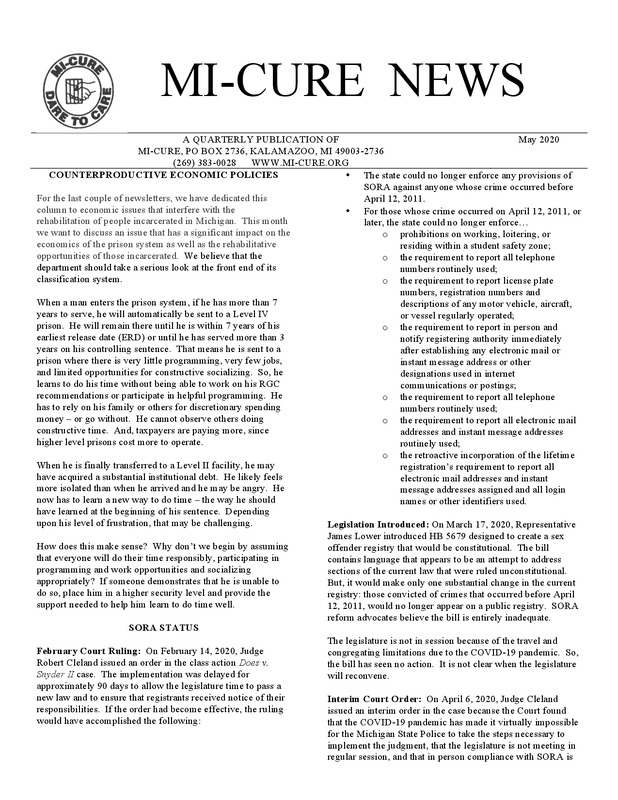
MI-CURE News (May 2020) covering harmful classification practices that hinder rehabilitation; court rulings and stalled legislation on Michigan’s sex offender registry (SORA); efforts to reduce jail and prison populations during COVID-19; new bills to improve conditions for incarcerated women; racial bias in risk assessment tools; trauma-informed interventions like SURE Moms; critiques of felony disenfranchisement; recommendations to overhaul pretrial systems and eliminate cash bail; juvenile abuse; updates on life sentences and solitary confinement reform in Canada.
MI-CURE News (May 2021) covering prison food reform and gardening programs; tablet access and proposed free prison calls; expansion of public defender and social worker defense programs; STEM education efforts by and for the incarcerated; 2020 exoneration trends and misconduct patterns; trial penalty; prosecutorial reform initiatives; new juvenile LWOP policie; SCOTUS ruling on juvenile sentencing; Virginia bill on autism and mental illness in court; and Michigan AG’s attempt to seize prisoner stimulus checks.